Table of Contents
Table of Contents
- Do you need a license to start a landscaping business in Ohio?
- What are the types of landscaping business licenses and permits in Ohio?
- Business license
- Vendor’s license
- Dealer’s licenses
- Pesticide applicator permits
- Step-by-step process to get a landscaping business license in Ohio
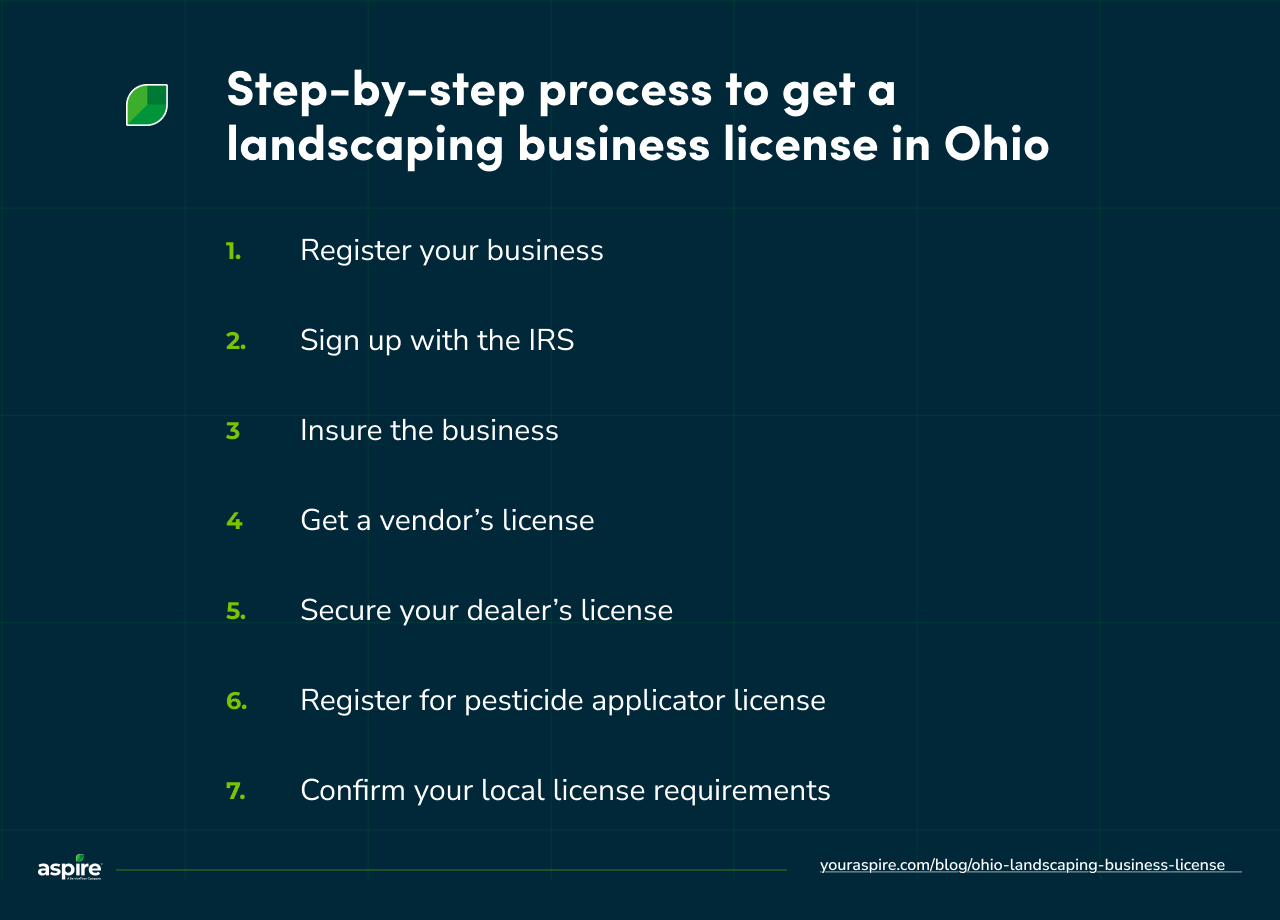
- 1. Register your business
- 2. Sign up with the IRS
- 3. Insure the business
- 4. Get a vendor’s license
- 5. Secure your dealer’s license
- 6. Register for a pesticide business license
- 7. Confirm your local license requirements
- How much does an Ohio landscaping business license cost?
- General business registration fees
- Vendor’s license program
- Pesticide applicator license
- Dealer’s license program
- What are the most common mistakes to avoid when getting a license?
- 1. Skipping proper business registration
- 2. Forgetting insurance needs
- 3. Using unlicensed applicators
- How Aspire helps landscaping businesses stay organized, productive, and profitable
- Proposal management
- Invoicing and payment processing
- Business reporting & documentation
- Scheduling and job management
- Over to you
- Disclaimer
Ohio ranks as the best state in the U.S. to start a small business and as the fifth-best state in the nation for doing business in general. According to CNBC, its overall pro-business strengths in the economy, infrastructure, workforce, and business friendliness are all factors behind it.
Perhaps these reasons have convinced you that starting a landscaping business in Ohio is a good idea.
However, you’re unclear about how to navigate the licensing process required to begin operations.
Do you need a landscaping license, a specialized permit, or a sales tax license?
This guide answers those questions and breaks down the licensing process for aspiring landscape entrepreneurs like you.
Do you need a license to start a landscaping business in Ohio?
You don’t need a special landscaping license to start a landscaping company in Ohio.
However, your new business must be registered with the Ohio Secretary of State to operate legally, which requires a business license.
In addition to that, you will need a:
Vendor’s license once the landscaping business starts generating at least $5,000 in gross sales in a calendar year. This license helps you remit sales tax on all sales of services exceeding $5,000.
Dealer’s license to sell any vegetation or plants that can survive winter.
Pesticide applicator license to spray pesticides or fertilizers.
But for a start, a business registration with the Secretary of State is all that’s required.
What are the types of landscaping business licenses and permits in Ohio?
This section breaks down the different licenses your new landscaping business will need to run in the state.
Business license
The state of Ohio requires all new businesses to register with the Secretary of State.
You’ll need to confirm that your preferred business name is available.
Next, select your preferred business structure. This can be a sole proprietorship, a limited liability company, a limited partnership, or a corporation.
Then register the business by filing the appropriate forms for your legal structure.
Vendor’s license
According to Ohio’s Department of Taxation, new landscapers need a vendor’s license once they pass $5,000 in gross sales in one calendar year.
This license enables you to collect sales and use tax from customers and remit it to the Department of Taxation.
Dealer’s licenses
You need this license to sell nursery stock for plant installations.
If you’re selling or distributing nursery stock, meaning any hardy tree, shrub, plant, or bulb, whether wild or cultivated, a license is required.
If you intend to grow plants for sale or distribution, you would also need a certificate of nursery inspection.
Pesticide applicator permits
A pesticide applicator license is required for landscaping companies that intend to:
Apply pesticides to residential or commercial properties in Ohio.
Advertise pesticide application services in the state.
Conduct diagnostic inspections for wood-destroying insects (WDI) on a residential or commercial property.
Step-by-step process to get a landscaping business license in Ohio
Here’s a detailed roadmap to help you secure the necessary landscape permits in the state.
1. Register your business
Your new business needs to be registered with the Secretary of State. To do that, you need to:
Choose a legal structure that aligns with your business goals. You can select:
Sole proprietorship: Ideal if you want to manage the business alone. The good thing is there’s no partnership agreement, but your personal assets are at risk if any legal issues arise.
Partnership: If you have two or more partners. The business doesn’t pay taxes; instead, it passes through directly to each partner's personal tax return. However, personal assets remain at risk if the business incurs debt or faces disputes.
LLC: If you want individuals, corporations, other LLCs, or foreign entities to join the business. Offers personal liability protection, meaning your assets are protected if the business incurs debts or faces disputes. Like partnerships, taxes pass through to a partner's personal tax return.
Corporation: Best if you want to transfer shares easily. Offers the strongest liability protection, as shareholders are not responsible for debts or lawsuits. But profits are taxed twice, at the business and personal level.
Name your business. Choose a unique name that’s memorable for your audience. Visit the Secretary of State’s Business Services Division or call them at (877) 767-3453 to confirm the name is available.
File forms based on the business structure you selected. Here are the different forms you may need to fill out:
Sole proprietorship: FORM #534A
Partnerships: FORM #535
LLCs: FORM #533A
Corporations: FORM #532
Once you’re done filling out the form, submit it online at Ohio Business Central or on paper by sending the form by mail.
2. Sign up with the IRS
Next, you need to register with the IRS to obtain a federal Employer Identification Number (EIN).
With this number, the IRS identifies you as a business, enabling you to open a business bank account, hire workers, pay taxes, and build credibility for the company.
You can apply for an EIN online by visiting the IRS website and completing the application. You’ll need a Social Security number and a business structure to complete the registration.
3. Insure the business
In Ohio, employers with one or more workers are required to have workers’ compensation coverage. This is insurance that protects employees in case of a work-related injury, occupational disease, or death.
To find an insurance policy suitable for your business, consider reaching out to companies like Next Insurance or Insureon.
4. Get a vendor’s license
This permit is for new landscapers who have generated $5,000 or more in gross revenue.
You can register for it through the Ohio Tax eServices or with your county auditors.
The eServices path helps you secure the license immediately. However, you need to create an account with OH|Tax eServices and then request the vendor’s permit.
If you want to apply with your county auditor, visit this link for a list of auditors in the state and contact one closest to you.
5. Secure your dealer’s license
If you’re interested in selling, distributing, and installing nursery stock (plants), you need a dealer’s license from the Plant Health Division of the Ohio Department of Agriculture.
You can get one online:
Visit the Nursery Inspection Licensing System (NILS) portal.
Get an organization key emailed to you.
Use the key to create a User Account and access your organization’s information to request a license.
You can also apply for it by mail:
Fill this application form.
Submit it to the division’s address at 8995 E. Main Street, Bldg 23, Reynoldsburg, Ohio.
Once your application has been approved and processed, the license will be available in your NILS portal.
6. Register for a pesticide business license
If pesticide application is included in your landscaping service list, you need a license from the Plant Health Division.
Here’s how to apply for a pesticide business license:
First, employ an Ohio-licensed commercial pesticide applicator for the location you’ll be operating from. If you intend to be a licensed applicator, obtain the applicator license before submitting the business application.
To qualify for the commercial pesticide applicator license, you must:
Pass the Core exam
Pass at least one Category exam
Submit the application and pay the license fee
Secondly, meet the insurance requirements for the business license. The department requires businesses to submit and maintain a Certificate of Insurance (COI) while the license is valid.
Read more about the insurance requirements here.
Thirdly, fill out, pay the license fee, and submit this application form to the Plant Health Division.
7. Confirm your local license requirements
After obtaining the state-level permits your landscaping business needs, check what the city or county where your business will operate requires.
For example, Hudson, Ohio, requires a permit for commercial and residential landscapers to operate. To be on the safe side, confirm what your city will need.
This usually includes:
Landscaping license
General contractor permits
Landscaping vehicle and driver’s license
Insurance policies (e.g., workers’ compensation, general liability, or equipment insurance)
Surety bond
How much does an Ohio landscaping business license cost?
Getting the different permits mentioned above isn’t entirely free. Here’s what it would cost to get them:
General business registration fees
Filing fees:
LLC: $99
Sole proprietorship: $39
Partnership: $99
Corporations: $99
Vendor’s license program
Cost: $50
Pesticide applicator license
Commercial applicators:
License fee: $35
Renewal fee: $35
Business license application fee: $35
Dealer’s license program
Application fee: $125 per location
In addition, you may need to pay monthly premiums for insurance policies. Prepare for other licensing fees from the local area where the landscaping business will operate.
What are the most common mistakes to avoid when getting a license?
Starting a new landscaping business is a challenging process. To ensure you have fewer delays and unnecessary run-ins with the law, here are common mistakes to avoid.
1. Skipping proper business registration
In Ohio, registering your business and choosing the right structure are among the most important early steps.
Skipping it or choosing the wrong structure can lead to fines, legal issues, or even business closure. It can also hurt your credibility with clients and local agencies.
If you’re unsure which structure best fits your goals, check out the SBA’s guide on choosing a business structure.
You can also find registration and filing details on the Ohio Secretary of State page.
2. Forgetting insurance needs
Insurance is a big deal for businesses in the Buckeye State. New companies must have coverage that protects both the business and its workers.
In fact, the Ohio Department of Agriculture requires a Certificate of Insurance (COI) as part of the pesticide business license application.
While there’s no separate form confirming your coverage during business registration, failing to secure insurance can lead to penalties. You’ll be personally responsible for any damages or incidents that occur.
Before starting the registration process or applying for your license, contact an insurance provider familiar with Ohio’s business policies (commercial and pesticide). They can help you get the right general liability coverage and provide a COI that meets state requirements.
3. Using unlicensed applicators
Allowing unlicensed applicators to handle or spray chemicals on client properties is a major compliance violation in Ohio. Even if you have a pesticide business license, the law requires that only accredited employees be allowed to apply pesticides.
As such, ensure you hire employees who have a commercial applicator license.
How Aspire helps landscaping businesses stay organized, productive, and profitable
Once your business is underway, you’ll have a lot to do — from client communication to marketing, crew management, project monitoring, and job scheduling.
Without the right tool, things can get messy. You might double-book on certain days, forget to assign projects, or calculate the wrong payroll.
A landscaping management tool like Aspire centralizes your operations, helping you stay organized and professional.
Here are the different ways Aspire can help you:
Proposal management
Aspire’s estimating features let you create professional estimates using preset labor and material costs.
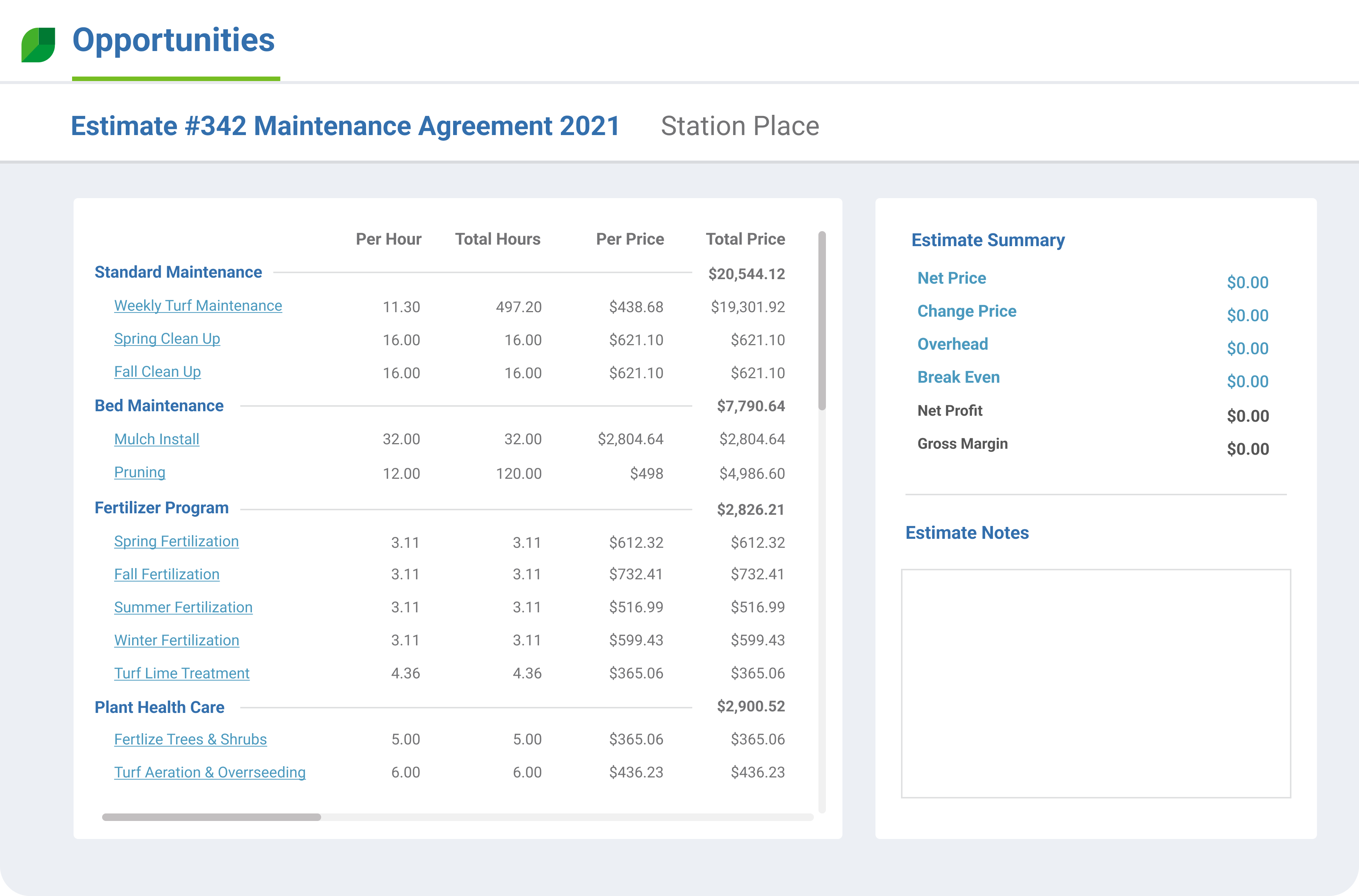
You have access to customizable proposal templates that let you add specific services from an existing catalog.
To ensure your proposals are profitable, defined margins and markups for labor, materials, and overhead are automatically factored in.
And when you’re done, the proposal can be sent via email or a customer portal on Aspire, where they can sign off on it.
Invoicing and payment processing
Aspire helps convert estimates into invoices once the project is completed.
Since the data you need for an invoice already exists in the app, you just need to generate a new invoice, enter the date and invoice number, choose the client, and send it to them.
Additionally, Aspire’s invoicing feature allows you to monitor invoice status. You can follow the status of each invoice, whether it’s been paid, pending, or overdue.
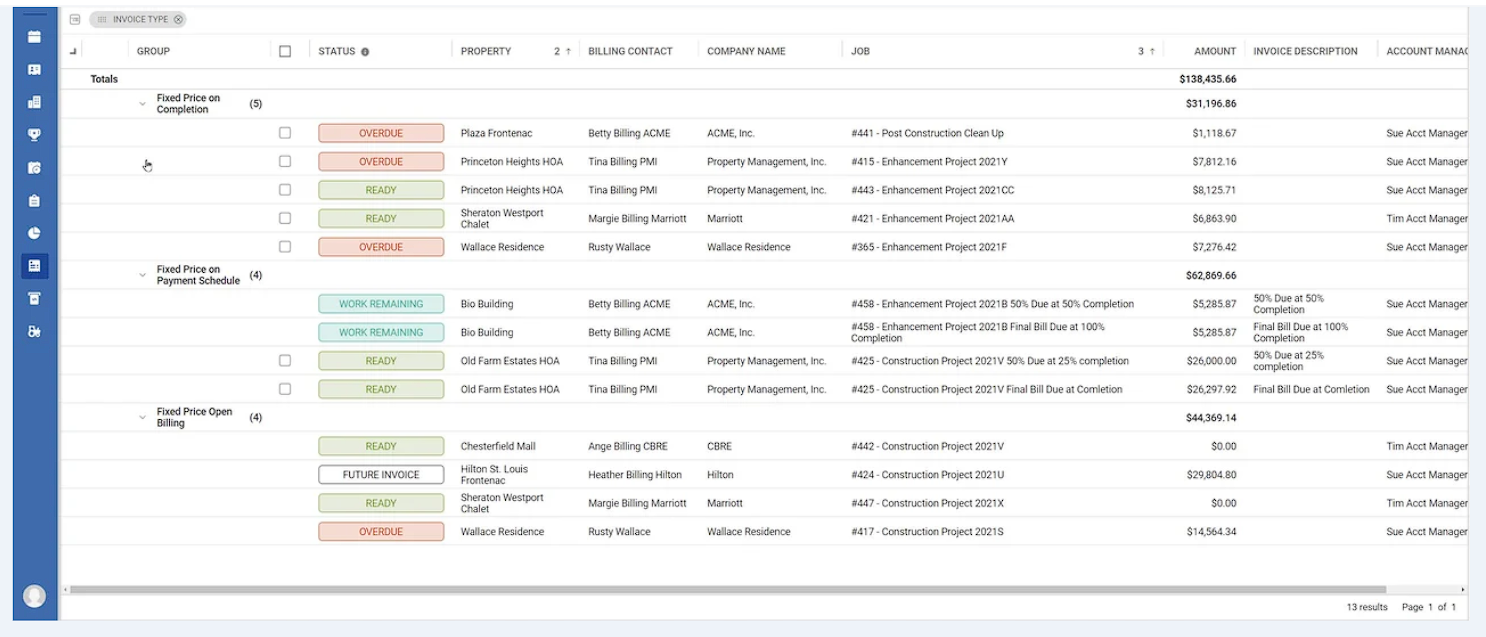
You can also receive payments, and since Aspire integrates with professional accounting software like QuickBooks, you can log paid invoices into your accounting system.
Business reporting & documentation
As you take on new projects and grow the business, you’ll need performance reports to see what's going on in the business.
Are you making profits or losing clients? Where do you need to improve?
Aspire’s reporting tool answers these questions and provides insights into your landscaping business's operations.
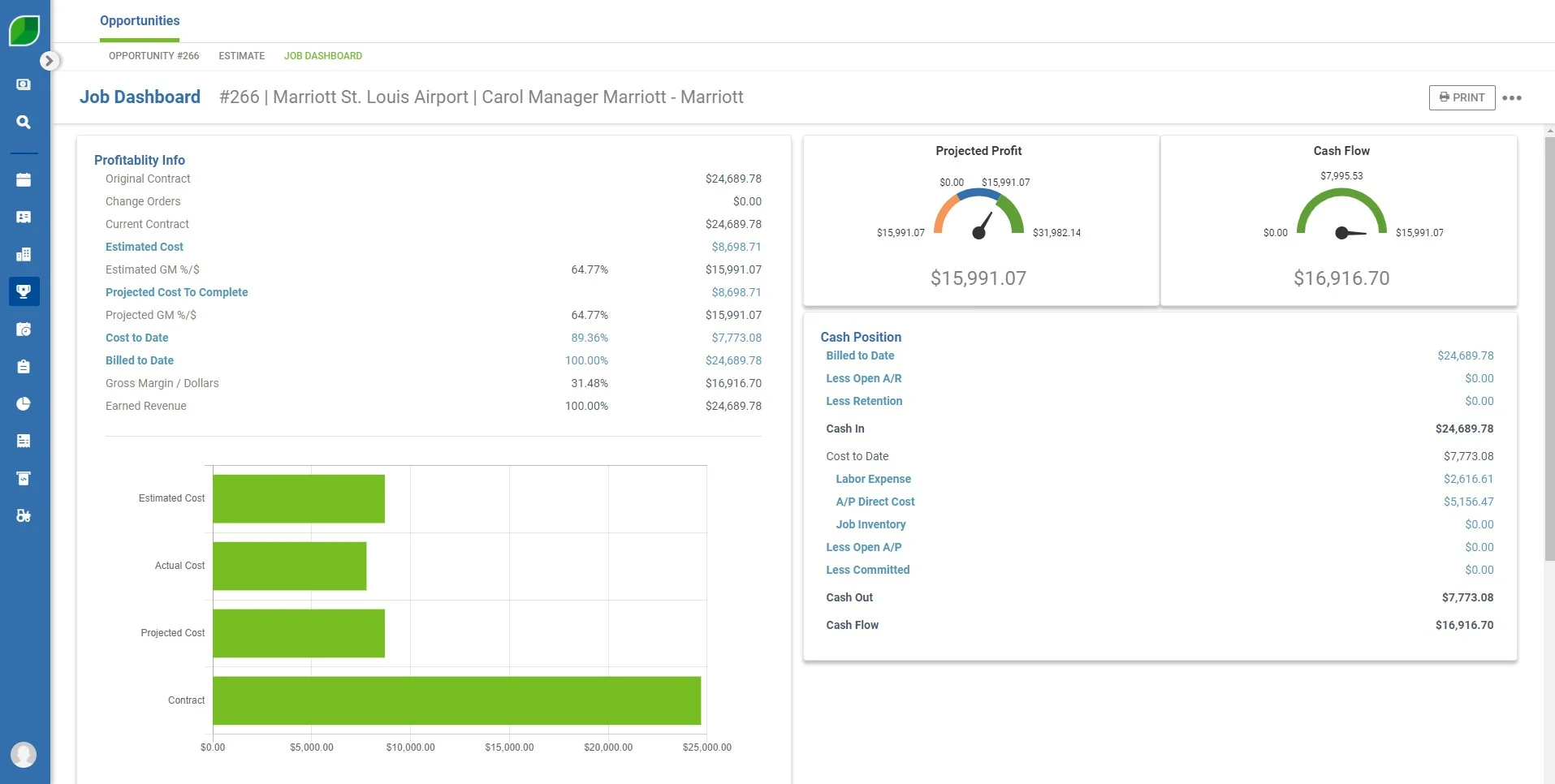
Here, you have access to metrics such as client retention rate, employee productivity, cash inflows and outflows, projected profit, direct costs, and job inventory.
You can track profit per job, cost per lead, and crew efficiency to help you make strategic decisions and grow the business.
Scheduling and job management
Handling multiple jobs simultaneously can be messy and overwhelming.
Imagine you have four seasonal clean-up clients, three mulching jobs, and about seven clients lined up for lawn mowing.
How do you manage them all without losing track of progress or mismatching crews and clients?
Aspire’s scheduling tool simplifies this with a centralized calendar, where you can schedule, view, and adjust projects.
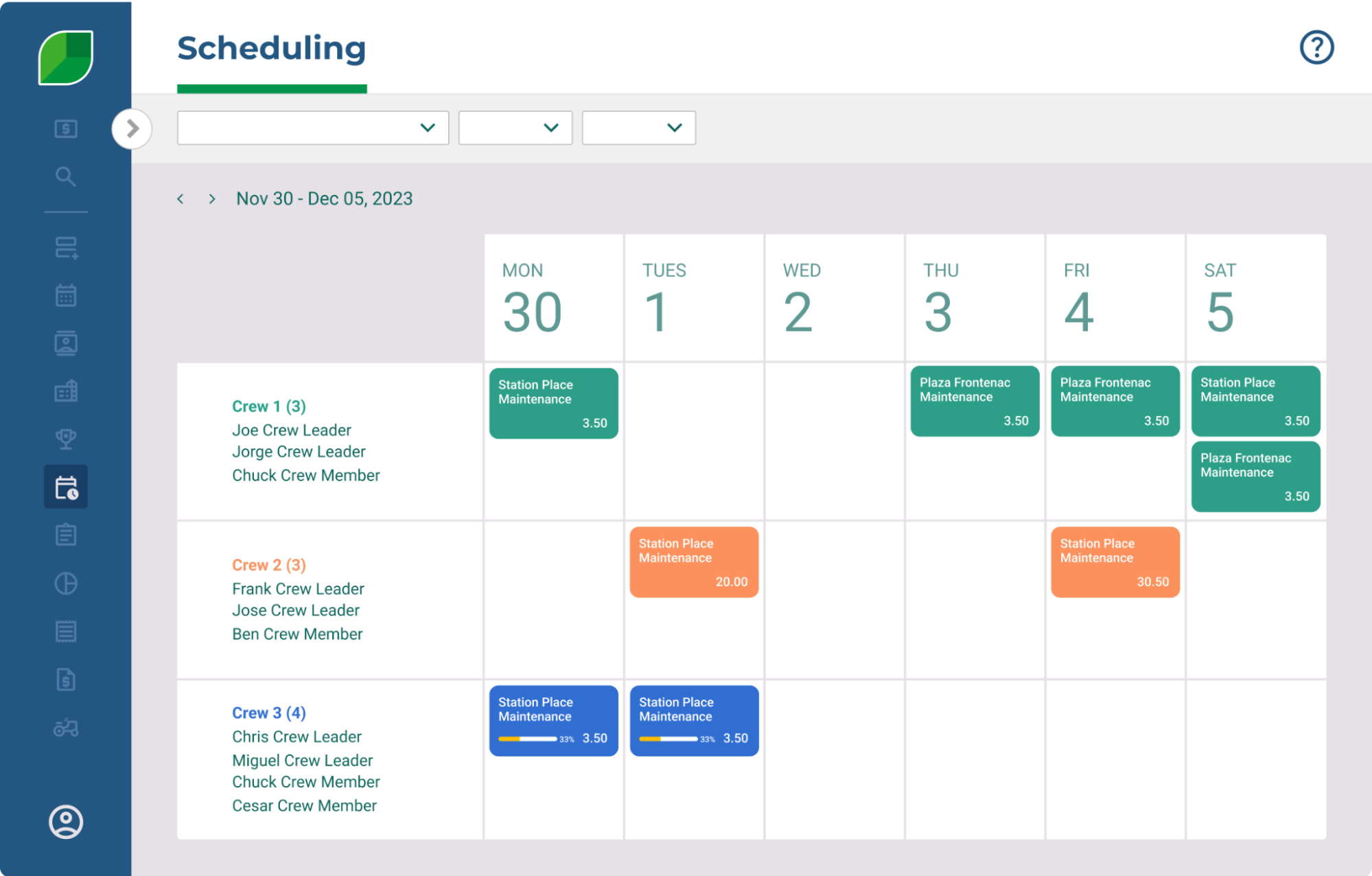
It allows you to assign tasks to specific crew members, set start and end times, and even add notes or checklists for each job.
Aspire offers real-time updates and mobile notifications, so everyone on the team knows where to go or what to do next.
Over to you
To recap, to start a landscaping business in Ohio, you need to:
Register the new business with the Ohio Secretary of State.
Get an EIN from the IRS.
Purchase an insurance policy.
Secure a vendor’s license once you generate over $5,000 in annual revenue.
Get a dealer’s permit and pesticide applicator license.
Check with the local county for specific landscaping permits.
To streamline the business and ensure everything runs smoothly and on track, invest in management software like Aspire.
It saves time, helps you avoid costly mistakes, makes the business look professional, and enables you to scale with ease.
Schedule a demo with Aspire today for a front-row seat to how it can help you stay organized and profitable.
Disclaimer
This article is for informational purposes only and should not be considered legal or financial advice. While every care was taken to use official sources, you should always verify requirements on the Ohio government websites.






 866-727-7473
 Schedule Demo
 390 S Woods Mill Rd #300 Chesterfield, MO 63017


