Table of Contents
Table of Contents
- Do you need a license to start a landscaping business in Colorado?
- What are the types of landscaping business licenses and permits in Colorado?
- General business license
- Landscaping contractor license
- Pesticide/herbicide applicator license
- Nursery program
- Step-by-step process to get a landscaping business license in Colorado
- 1. Choose a business structure
- 2. Secure a federal employer identification number (FEIN)
- 3. Register your business with the Colorado Secretary of State
- 4. Obtain a pesticide applicator license
- 5. Sign up for the nursery program
- 6. Check local license requirements
- 7. Maintain your record
- How much does a Colorado landscaping business license cost?
- General business fees
- Pesticide applicator license
- Nursery program
- What are the most common mistakes to avoid when getting a license?
- 1. Missing the nursery dealer license
- 2. Not understanding water-wise landscaping laws
- 3. Forgetting insurance
- 4. Ignoring renewals
- How Aspire helps landscaping businesses stay organized, compliant, and profitable
- Proposal management
- Invoicing and payment processing
- Business reporting and documentation
- Scheduling and job management
- Over to you
- Disclaimer
The landscaping industry in Colorado is changing fast.
Many cities are imposing strict turf limits on new properties, and a new Senate bill prohibits non-functional and artificial turf on commercial properties.
If you’re an entrepreneur interested in launching a new lawn care business in Colorado or want to expand here, you must understand the licensing requirements to operate legally in the state.
This guide will help new landscaping professionals navigate the licensing process, so they can launch and grow their business.
This article covers:
Types of licenses required in Colorado
Costs involved in getting a license
Step-by-step process for obtaining a landscaping business license
Mistakes to avoid when securing a license in the state, and more
Do you need a license to start a landscaping business in Colorado?
A landscaping license isn’t required to start a lawn-care company in Colorado. However, you do need a permit if you intend to offer herbicide or pesticide application services.
But in specific cities and municipalities (such as Castle Rock, Denver, or Boulder) landscapers need licenses to run their businesses.
So while there’s no state-wide landscaping license, specific municipalities often require special permits. As such, it’s crucial to check the contractor licensing requirements in the city or county you intend to operate in.
Here’s what you need to start a landscaping business in Colorado:
Business registration with the state.
Herbicide/pesticide applicator license (if they are part of your service).
Sales tax permit to sell taxable commodities such as native plants (if that’s part of what you offer).
What are the types of landscaping business licenses and permits in Colorado?
Wondering whether you need to register your business with the state or county? Or perhaps you just need a federal tax identification number?
Here’s everything required to operate a landscaping business in the Centennial state:
General business license
New businesses in Colorado must register with the Colorado Secretary of State to operate legally. More specifically, you must select a legal structure and choose and register your business name.
It’s only after you’re set up with the Secretary of State that you can proceed to secure other permits your landscaping business will require.
Landscaping contractor license
While you don’t need a statewide landscaping license to operate, these cities require landscapers to be licensed and registered:
Boulder
Denver
Aurora
Colorado Springs
And to apply for a landscaping license, you will need to:
Fill out an application form.
Provide proof of insurance (general liability and workers’ compensation).
Secure a surety bond.
Pay an application fee.
The bottom line: licensing requirements vary significantly across Colorado cities. Your best option is to confirm what’s required in your county by visiting the city website or contacting your local city or county clerk’s office to ask about landscaping, lawn care, or contractor licensing requirements.
Pesticide/herbicide applicator license
If your landscaping service will include applying pesticides, you need a license from the Colorado Department of Agriculture.
Here are the requirements to apply for a commercial applicator license:
A qualified supervisor to work for the commercial business.
A minimum of $400,000 general liability insurance.
Certificate of good standing issued by the Secretary of State for corporations or LLCs.
Driver’s license or ID for sole proprietors.
Doing business as (DBA) forms if you’re operating under more than one business name from a single location.
Once you have all the requirements (as a sole proprietor, LLC, or corporation) you can apply for the license.
You’ll be notified by email if the application has been approved or rejected, along with the next steps.
Nursery program
You need to register with the nursery program if you intend to:
Collect nursery stock from native growing habitats and sell it.
Provide nursery stock for compensation or value as part of a site development or landscaping service.
If you own premises where nursery stock is grown for sale, or if you plan to plant and sell turfgrass sod, you also need to be registered with the nursery program.
To apply, send an email to cda_nursery@state.co.us for instructions on how to get started.
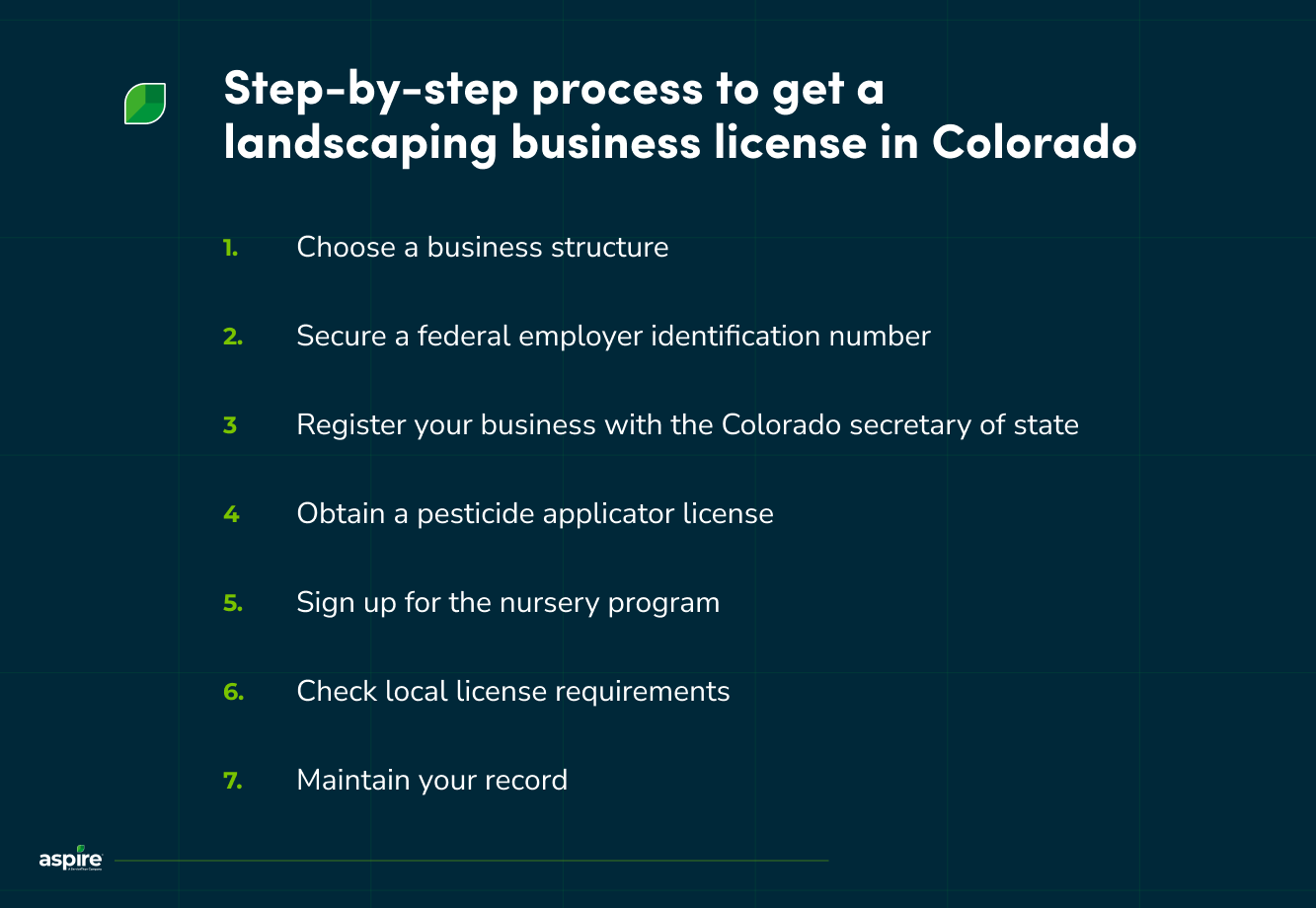
Step-by-step process to get a landscaping business license in Colorado
Now that you know the different licenses you may need, here’s how to get them:
1. Choose a business structure
Consider the structure for your new landscaping business. If you plan to do this alone, a sole proprietorship is probably your best choice.
Opting for an LLC or a corporation is smarter if you have a partner and want to quickly expand your landscaping business.
It also makes your business appear more trustworthy to clients and creates a legal separation between you and the organization.
In a sole proprietorship, you and the business are the same legal entity, meaning your savings or assets can be used to pay business debts or lawsuits.
An LLC or corporation establishes the business as its own legal entity. This structure provides legal protection for your personal assets if the business fails or is sued.
2. Secure a federal employer identification number (FEIN)
A FEIN is necessary for tax purposes, opening a business bank account, and adding more credibility to your landscaping business. You also need it to hire employees.
Here’s how to get one:
Prepare your Social Security number.
Choose a business entity type (discussed in the previous step).
Visit the IRS website and complete the application.
3. Register your business with the Colorado Secretary of State
Your business needs to be registered with the Colorado SOS to operate within the state. Here’s how to get it done:
Determine the business structure: Choose between a sole proprietorship (running the business alone), a limited liability company, or a corporation.
When registering as a sole proprietor, you only need to file a Statement of Trade Name of an Individual with the state secretary and pay the required fees.
For other business structures, you may need to file articles of organization, a statement of registration, or articles of incorporation along with the required fees.
Choose your business name and confirm it’s available: Enter the desired name into the Name Availability Search page with a corresponding abbreviation (e.g., Ltd. or LLC). The system will indicate whether the name is available. Sole proprietors can skip this step as their business trade names are not required to be unique.
File your documents: From the Secretary of State’s homepage, select Businesses, trademarks, tradenames > File a business document > File a form to create a NEW record. Then, click on your corresponding business structure’s file name and pay the $50 fee to complete the process.
4. Obtain a pesticide applicator license
Apply for a pesticide license from the Colorado Department of Agriculture if pesticide application is part of your service offering.
You’ll need a business license (commercial applicator) for your company, and individual licenses for persons applying the chemicals (qualified supervisor and certified operator).
To apply for a commercial applicator license, you need to:
Employ or secure the services by documented agreement of at least one qualified supervisor licensed in the pesticide application category or subcategory that you’ll be offering to clients.
Provide proof of required insurance.
Obtain and submit a Certificate of Good Standing from the Secretary of State as a corporation, a limited liability partnership, or a limited liability company.
Submit a copy of the FAA certification under 14 CFR Part 137 (for aerial applicators).
Submit a properly completed application and the $350 fee.
For your commercial license to be approved, you need to either hire a qualified supervisor or be certified as one.
Here are the requirements to become a qualified supervisor:
Apply and complete the general exam, plus the specific exams for all categories applicable to the pesticide applications your business will provide. The CDA recommends a pass mark of 70% or higher on all exams.
Have the required experience and qualifications specified in the rule.
Submit a driver’s license or government-issued ID.
Submit a properly completed application and the $100 license fee.
Both licenses require annual renewal, or you lose the permit.
5. Sign up for the nursery program
You need a license if you supply plants as part of your landscaping services, grow or sell them, or gather plants or sods.
Signing up is relatively easy.
Email the Department of Agriculture's nursery section at this address: cda_nursery@state.co.us for the application form and requirements.
After completing the application, send it back via email with the subject ‘Electronic Application’. Ensure you include a contact number and preferred payment method.
6. Check local license requirements
Once you’ve secured the permits you need at the state level, check in with the city where your business is located regarding its specific license requirements for landscaping services.
The requirements typically vary, but they usually include:
Landscaping license.
General contractor permits.
Insurance policies (e.g., workers’ compensation, general liability, or equipment insurance).
Surety bond.
To ensure you get everything that’s needed, contact your local clerk's office.
7. Maintain your record
Colorado requires LLCs and corporations to submit periodic reports. The report lets you verify or update your:
Official business name and ID number
Principal office street and mailing address
Name and address of the person filing the report
Registered agent information
This costs $25, or $50 if you fail to renew on time.
The periodic filing can be done online and will keep your business in good standing with the state.
Aside from the periodic filing, you also need to renew the pesticide applicator license annually to stay in operation.
How much does a Colorado landscaping business license cost?
Here’s what it would cost to obtain the licenses discussed above:
General business fees
Filing fees:
LLC: $50
Trade name: $20
Corporation: $50
Annual periodic reporting for corporations and LLC: $20
Pesticide applicator license
Commercial applicators:
Application and renewal fee: $350
Qualified supervisor
Application license fee: $100
Examination fee: $41.50 per test
Renewal fee: $100
Nursery program
Registration fees: $170
Inspection fee: $45/hr.
Keep in mind that you might incur additional costs from the city where your business operates.
What are the most common mistakes to avoid when getting a license?
Licensing mistakes can be costly for a landscaping business just starting out. One missed requirement could mean a halt to operations while you fix regulatory issues or pay the required fines.
Save yourself the stress by avoiding these common errors:
1. Missing the nursery dealer license
Considering everything that has to be done when launching a business, getting a license to supply or sell plants can slip through the cracks.
Colorado requires landscapers who grow, sell, or distribute nursery stock for commercial purposes to be licensed.
This permit helps reduce the risk of introducing foreign plant pathogens and insects into the state.
2. Not understanding water-wise landscaping laws
Colorado is cracking down on water waste in landscaping, as it’s a semi-arid state. Cities like Aurora, Castle Rock, and Broomfield have set strict turf limits for new construction projects.
In fact, effective January 2026, there’s a new law that prohibits non-functional turf on commercial properties, parking lots, and industrial sites. Artificial turf also won’t be allowed on commercial buildings.
For a new business, advertising services like decorative turf or decorative grass isn’t just illegal but also inconsiderate of the state’s water shortage.
Here’s what you can do instead: market xeriscaping, turf removal, native plant installations, and water-efficient irrigation systems.
3. Forgetting insurance
While insurance isn’t a requirement when registering your business with the state, it’s needed for a pesticide applicator license.
Failing to secure the minimum required insurance can delay your license approval.
Consult with the local city clerk about any other insurance or bonding requirements your lawn care business might need.
4. Ignoring renewals
Whether it’s the periodic reporting that the Secretary of State requires or renewal for your pesticide permits, license renewals are crucial.
Letting them expire means you can’t legally operate and will be asked to pay fines. Add the license renewal or periodic reporting dates to your calendar so you never forget.
How Aspire helps landscaping businesses stay organized, compliant, and profitable
Aspire is a landscaping management software platform that enables businesses to streamline their operations.
It provides a simplified way of managing your landscaping company, so you don’t have to do things manually.
For instance, instead of going out into the field to take measurements before manually calculating job estimates, Aspire offers tools to help measure properties from digital maps.
As you measure, the platform can calculate project time, material, and cost estimates with data imported from your own pricing database.
Here are other ways Aspire helps you stay organized and profitable:
Proposal management
The typical way of sending proposals to clients is to design a document from scratch with your branding and manually add service and pricing information.
That can take a lot of time.
A much faster way is to use Aspire’s estimating feature to generate and send proposals.
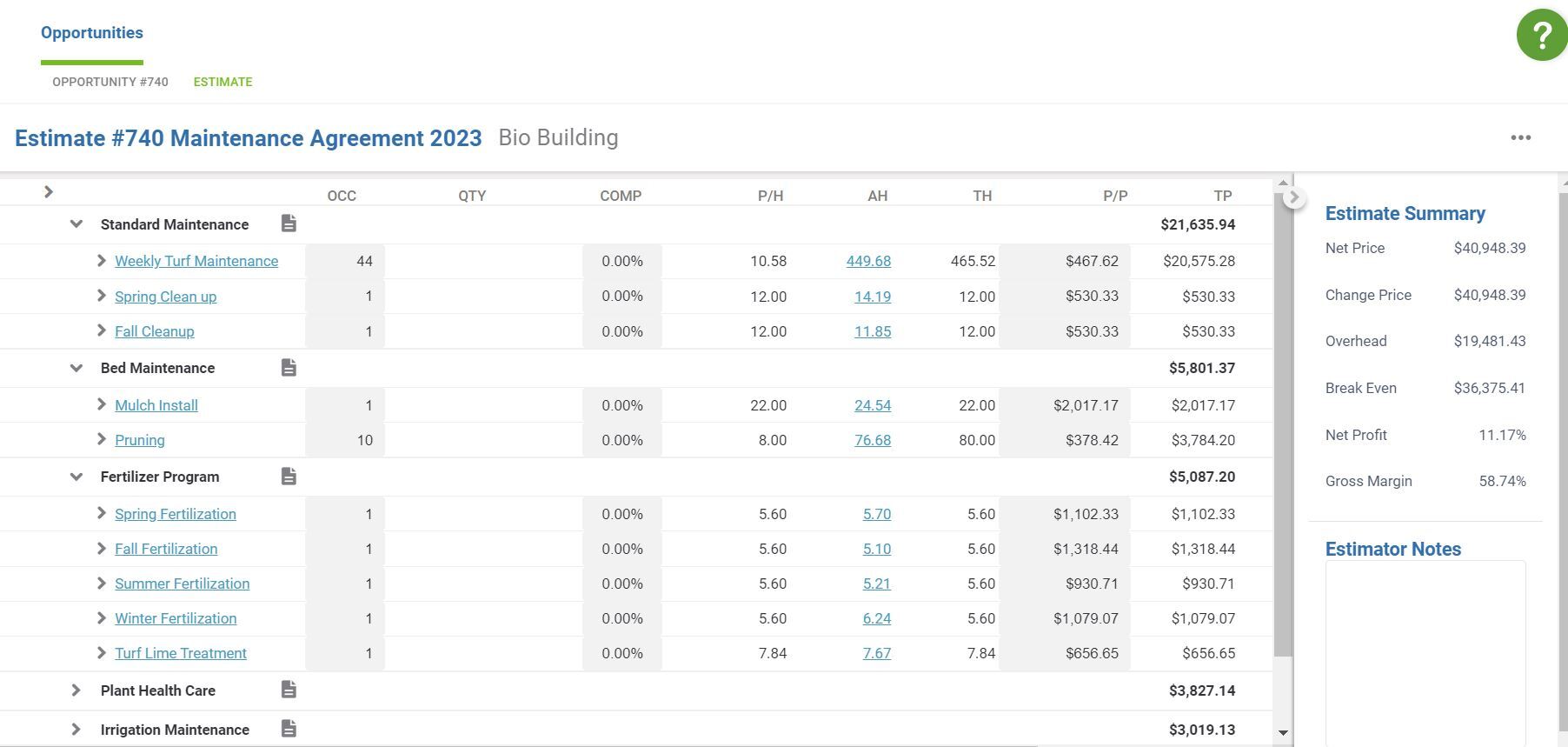
This feature provides professional, customizable proposal templates, where you can add the desired service from your catalog.
The margins and markups you’ve defined for labor, materials, and other direct costs are automatically factored into the proposal, ensuring profitability.
Once it’s ready, clients can view the proposal and approve it by signing in to Aspire’s customer portal.
In addition, all client proposals are stored in a single location, allowing you to assess which project requires specialized licenses. You can obtain the necessary permits for your jobs in advance, or partner with a landscaper who already has them, to ensure compliance.
Invoicing and payment processing
A client has accepted your proposal and signed the contract. Things are looking good, but you need to send an invoice so they’re clear about the financial structure.
Instead of creating an Excel document, manually adding services and pricing, and designing it from scratch, use Aspire’s Invoicing feature to create and send invoices with ease.
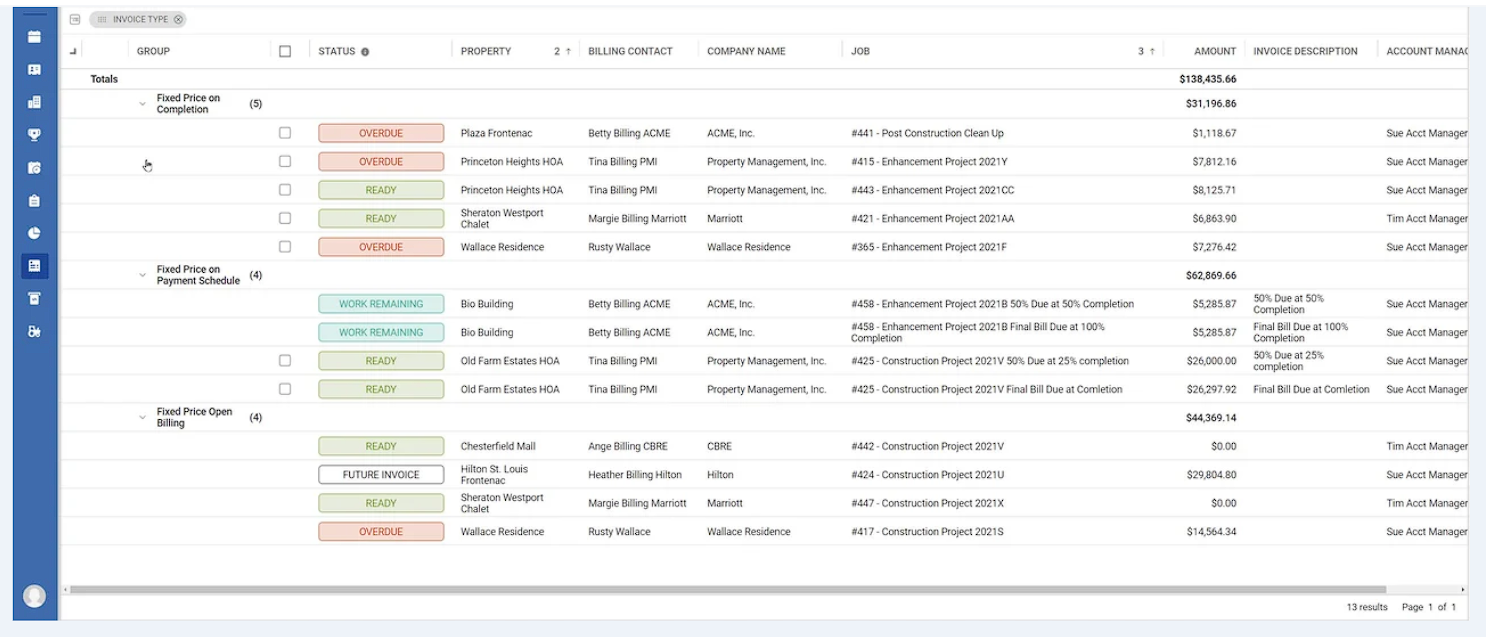
The data you need to create the invoice already exists within Aspire, thanks to the Estimates feature. Your job is simply to start a new invoice, enter the date and invoice number, select the client, and send it to them.
You can also receive payments and track financial transactions in Aspire, including paid, overdue, and outstanding invoices.
Business reporting and documentation
As a business owner, you need a way to monitor your entire operation and track things like what project type brings in the most profit or what’s draining your resources.
With Aspire’s reporting tool, you can monitor metrics like client retention rate, employee productivity, cash inflow and outflow, projected profit, direct costs, and job inventory.
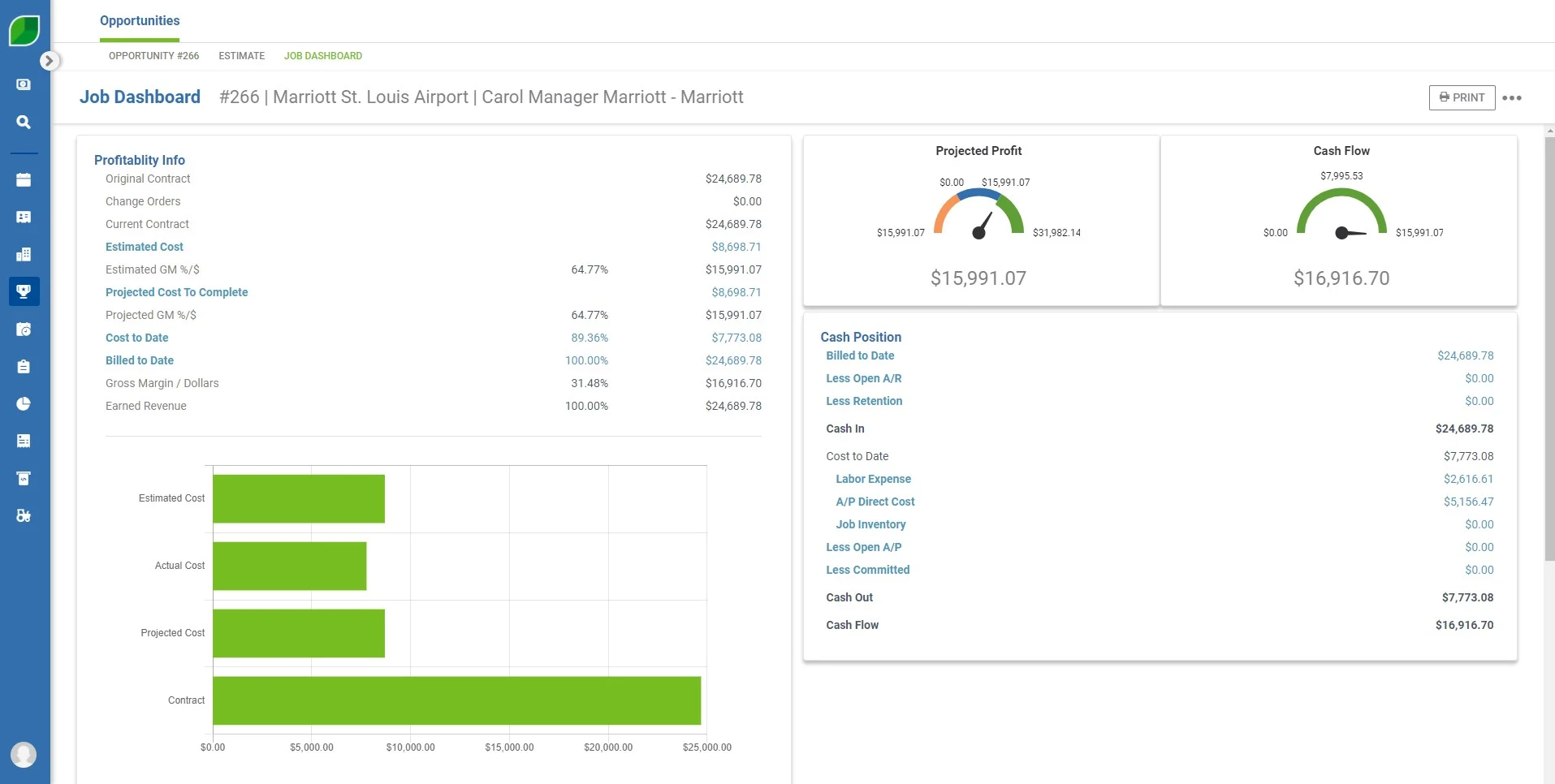
You get detailed insights into each project’s performance and information about your business as a whole, so you can make strategic decisions.
Scheduling and job management
With the new contract won, you need to plan your schedule so that no projects overlap.
Aspire’s Scheduling feature enables you to organize projects as they come in, assign crews based on availability and expertise, and optimize your routes.
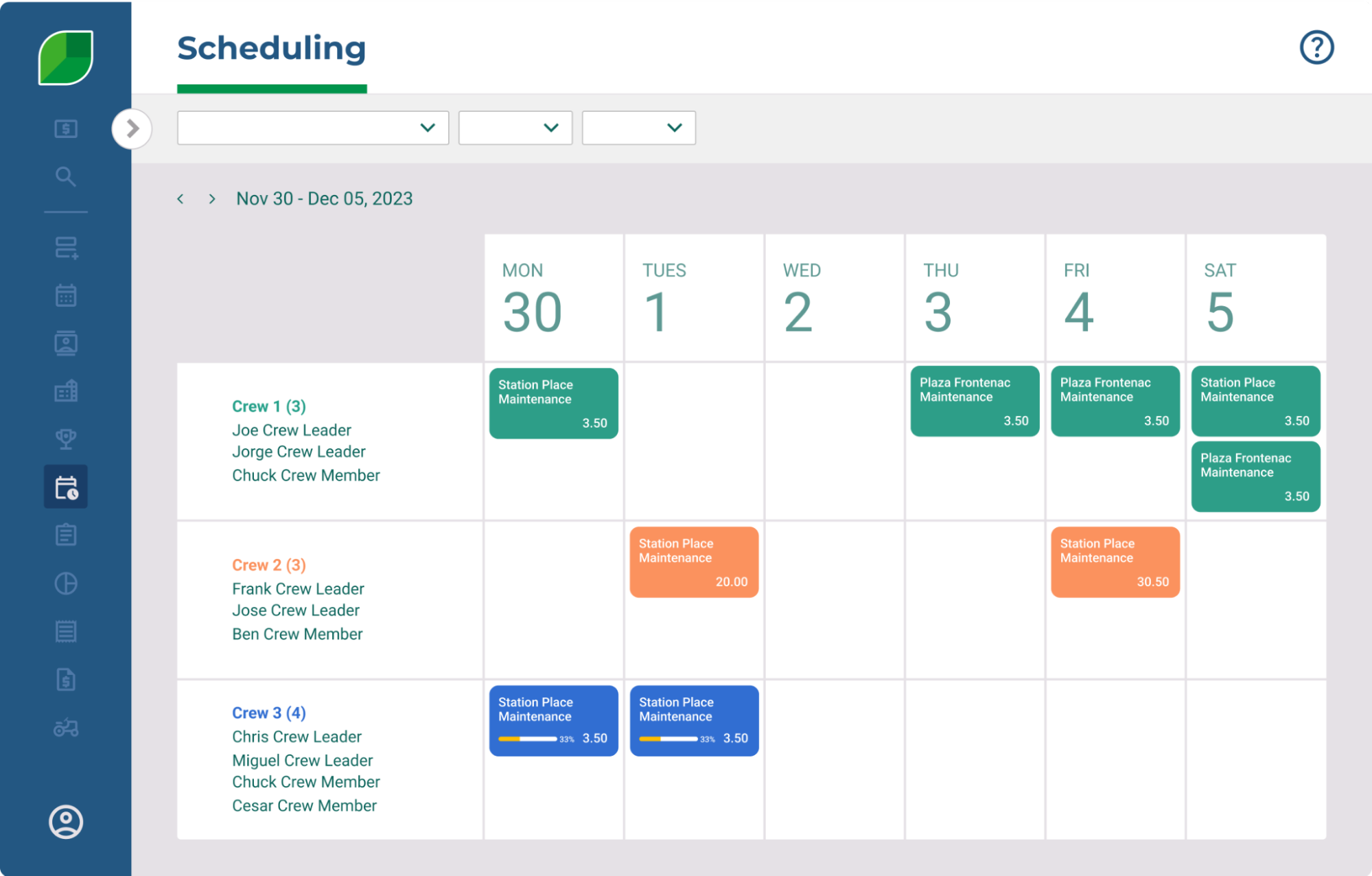
Your crew can view each project as a work ticket with the client’s address, property details, and special notes/requests.
There’s also a breakdown of the job’s actual hours, supplies/materials, labor costs, and equipment and sub-contractor costs.
Over to you
To start a landscaping business in Colorado, you need to register your business with the state, secure your FEIN, get a pesticide applicator license, and get into the nursery program.
Operationally, you need to invest in a field service management tool like Aspire to keep the business running smoothly. It will help you take control of your business so you can grow it quickly.
Book a free demo to see how it works in real time today.
Disclaimer
This article is for informational purposes only and should not be considered legal or financial advice. While every care was taken to use official sources, you should always verify requirements on the Colorado government websites.





 866-727-7473
 Schedule Demo
 390 S Woods Mill Rd #300 Chesterfield, MO 63017


