Table of Contents
Table of Contents
- What is markup in landscaping?
- Why do landscaping businesses use markup?
- How is markup calculated for landscaping jobs?
- What is a typical markup percentage in landscaping?
- How markup differs for residential vs. commercial landscaping
- What factors affect the markup rate in landscaping?
- How do you price landscaping materials with markup?
- How do you price landscaping labor with a markup?
- What is the cost-plus pricing model in landscaping?
- Step 1: Estimate your labor costs
- Step 2: Calculate material costs
- Step 3: Estimate overhead
- Step 4: Total all costs
- Step 5: Add your markup percentage to get the final price
- How does markup impact landscaping profit margins?
- The difference between markup and margin
- How do you ensure your markup is competitive?
- When should you change your landscaping markup rates?
- What mistakes should you avoid when setting markup?
- How do you communicate markup to landscaping clients?
- How landscaping management software helps with markup
Ever heard the term ‘markup’ thrown about when it comes to landscaping pricing?
It’s often mentioned alongside phrases like ‘overhead’, ‘financial health’, ‘profit’, and ‘accurate pricing’, but rarely explained.
In this guide, you will understand what markup is and how it applies to your landscaping business. More specifically, you’ll learn:
How it’s calculated for lawn care services
The average markup percentage for landscaping contractors
How to price landscaping services with markup
How markup differs for residential vs. commercial work
The ideal time to change your markup rates
You will go from wondering what markup is all about to understanding exactly how to calculate and apply it so you can price your services with confidence.
What is markup in landscaping?
Markup is the percentage you add on top of your direct costs, labor, materials, and equipment to cover overhead and generate profit. It’s the difference between what a job costs you and what you charge the client.
Let’s say you want to send a quote for a landscaping project (e.g., mulch installation job), and it’ll cost you $500 to complete the project, $300 for mulching and edging materials, and $200 for labor.
If you send a $500 estimate to the client, your business will run at a loss; you would make just enough to cover the materials and labor, and you wouldn’t be able to pay for gas, rent, or utilities, let alone earn any profit.
To turn a profit, your final price needs to account for overhead (truck payment, rent, admin costs, insurance, bond, etc.), landscaping taxes, and unexpected costs, as well as your profit.
All those add-ons are referred to as markup.
Why do landscaping businesses use markup?
Markup helps you stay in business. It ensures your business expenses, including direct labor costs, are covered in every estimate or quote you send to your clients.
To be more specific, here’s why landscapers use markup:
Protects the business from going under: One mistake a landscaper can make is relying solely on labor costs and materials to determine the total project price.
If that’s how calculation is done, you’re not accounting for profit or actual business expenses. Without markup, you will have zero for rent, utilities, or take-home money.
Covers hidden costs: Sometimes, there are expenses you may not remember when pricing landscaping jobs. Markup ensures you cover everything from labor burden (e.g., salaries, overtime, and external contractors) to overhead costs (e.g., rent, marketing, and utilities) and hidden expenses (e.g., equipment maintenance and administrative bills).
Prevents underpricing: With a markup, your final prices are determined by cost analysis rather than a rough estimate based on competitors' pricing. This ensures you’re not underquoting or shrinking your profits.
Create sustainable profits: Pricing with a well-calculated markup ensures you have the maximum profit margin. Once you know your correct markup percentage, it becomes easier to price jobs, hit your profit targets, and plan your business growth.
How is markup calculated for landscaping jobs?
There are several ways to calculate the markup percentage. It can be calculated using the service cost and markup amount or based on your desired profit margin.
For service costs, here’s the formula for markup percentage:
Markup percentage = Markup amount / Project cost x 100
Find the markup amount.
Markup amount = Average selling price - Project cost
Say your average selling price for mulch installation is $1000, and the project cost is $600.
In that case, the markup amount would be: $1,000 - $600 = $400
Divide the markup amount by the project cost.
Continuing our example: 400 ÷ 600 = 0.6667
Multiply by 100 to get your markup percentage.
0.6667 x 100 = 66.67%
To calculate markup based on a specific profit margin you’d like to reach, use this formula:
Markup %= [Desired profit margin ÷ (1 - desired margin) × 100]
Say your desired profit margin is 30% (0.3)
Markup % = [0.3 ÷ (1 - 0.3) x 100] = [0.3 ÷ 0.7 x 100] = [0.42857 x 100] = 42.9%
What is a typical markup percentage in landscaping?
The average profit margin for landscapers ranges from 15% to 25% for residential clients and from 10% to 15% for commercial clients.
To achieve those margins, you need a markup percentage somewhat higher than that range.
Using the markup formula (Markup %= [Desired profit margin ÷ (1 - desired margin) × 100]), this means the average markup percentage for residential clients will be 17.6% to 33.3%, and between 11.1% and 17.6% for commercial clients.
How markup differs for residential vs. commercial landscaping
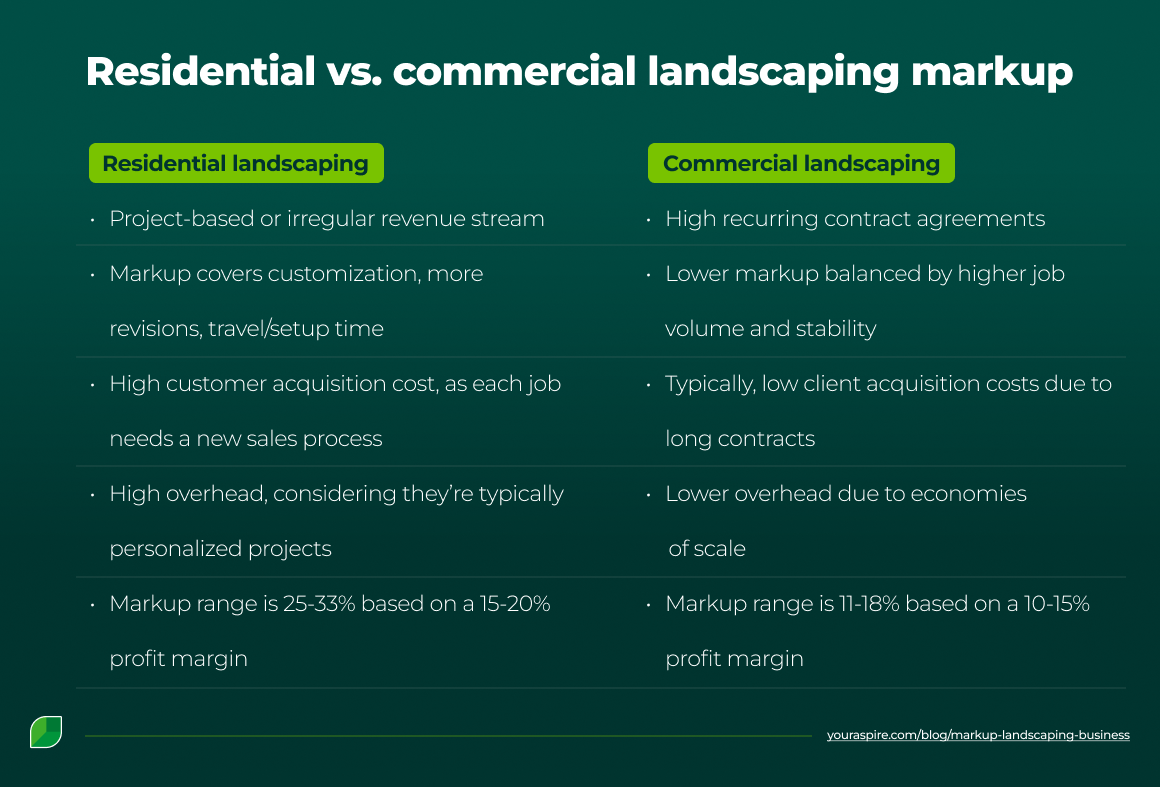
Residential landscaping projects typically have higher markups than commercial ones because they demand personalized service and premium pricing. They also involve more custom requests and are often one-off jobs, which means they command higher prices.
Since it's typically a one-time project, you can't spread costs across multiple visits or offer volume discounts on materials and labor, which increases the final price.
Commercial landscaping, on the other hand, is highly competitive, with bidding processes that drive down margins. However, commercial work often offers long-term contracts and predictable schedules, enabling you to accept lower margins in exchange for steady, recurring revenue.
Here’s a table explaining how they differ:
What factors affect the markup rate in landscaping?
Markup rates aren’t fixed; they vary based on factors such as job size, overhead expenses, and a project’s level of competition.
Below is a list of different elements that influence landscaping markups.
Overhead costs: Fixed costs like insurance, vehicles, software, admin fees, and rent are an important part of your business, and markups help cover them.
If you have high monthly overhead expenses, your markup will need to reflect that for your business to be profitable.
Job type: Markups are also defined by the type of client you’re working for. Residential clients command higher markups because they typically require personalization, more revisions, and represent irregular revenue streams.
Higher markups allow you to get high profit margins. But when working with commercial clients, you can opt for lower markups, as projects are balanced by higher job volume and income stability.
Market competition: In crowded markets, you may need low markups to stay competitive. Competitive projects with several bidders will result in lower margins than custom-design jobs.
Labor costs: Locations with highly skilled labor incur higher labor costs. Higher wages require higher markups, and low labor costs result in lower markups.
How do you price landscaping materials with markup?
Pricing landscaping materials with markup refers to how much you intend to charge clients for supplies needed to complete a project.
To do that, you need to determine the material’s cost per unit, quantity required, waste/overage allowance, and the delivery fees (where applicable).
Then, you apply a markup percentage and calculate the final price.
Here’s an example:
Calculate your material cost.
Mulch: 20 cubic yards × $30/yard = $600
Plants: 15 shrubs × $25 each = $375
Total material cost: $975
Apply your markup and calculate the price. For this example, we’ll assume a markup of 20% (0.20).
Total material cost × (1 + Markup %) = $975 x (1 + 0.20) = $975 x 1.20 = $1170
The final price to charge customers for materials is $1170.
The material markup isn’t just a way to make quick profits for your business. It pays for:
Time spent sourcing and ordering the materials
Transportation/delivery coordination
Storage and handling
Risk of damage or waste
Warranty/replacement guarantees
Your expertise in material selection
Essentially, clients are being charged for a guarantee that the materials will deliver their desired outcome.
How do you price landscaping labor with a markup?
You also need to add markup to labor costs to ensure profitability.
For this, you need to define your crew’s hourly wages with taxes, insurance, and benefits. Then, apply a markup percentage to get the final price.
Let’s say your crew’s hourly cost, along with wages, taxes, and benefits, is $25 per hour, and your markup is 20% (0.20).
To get fair labor pricing for clients, multiply the base rate by (1 + markup rate).
In this case, that’s $25 × (1 + 0.20) = $30/hour.
That’s what you charge clients for labor.
What is the cost-plus pricing model in landscaping?
Cost-plus pricing is one of the easiest models that landscapers use to price their projects. In this model, you base the price on real project costs and then add a markup to ensure profitability.
Here’s a step-by-step process of how it’s done:
Step 1: Estimate your labor costs
To calculate the labor cost for a landscape project, multiply the number of hours needed for the job by your hourly labor rate.
If a job takes 30 hours and requires three landscapers working simultaneously, the total labor hours required are 90.
If the hourly cost is $25, the total labor cost for the job is: 90 x $25 = $2,250
Step 2: Calculate material costs
List the materials needed for the job, their corresponding quantities, and calculate the total cost with taxes.
For instance:
Mulch: 20 cubic yards × $30/yard = $600
Plants: 15 shrubs × $25 each = $375
Total material cost: $975
Step 3: Estimate overhead
The overhead includes the indirect expenses required to run your business, such as utilities, rent, marketing, phone bills, internet, insurance, and a landscaping software subscription.
To estimate the overhead costs for a landscaping job:
Calculate your weekly overhead (say $2,000).
Estimate the number of weekly labor hours worked (e.g., 120).
Divide the weekly overhead cost by the number of hours worked to get the hourly overhead cost. In our example, that’s $2,000 ÷ 120 = $16.67. So, for each hour of labor, you need $16.67 to cover overhead costs.
Next, multiply the hourly overhead cost by the number of hours required for the job to calculate the project's overhead cost. $16.67 x 90 ≈ $1500.
Step 4: Total all costs
Labor + materials + overhead = $2250 + $975 + $1500 = $4728
Step 5: Add your markup percentage to get the final price
Let’s assume your markup is 20%.
The client price will be:
Total cost x (1 + 0.20) = $4728 x 1.2 = $5,674
How does markup impact landscaping profit margins?
Markup affects your selling price, which in turn impacts the profit margin.
While they’re connected, they don’t mean the same thing or grow at a similar rate.
Andrew Dickson, vice president of operations with LandOpt, explains it this way:
If you want to make a 40% gross profit margin, you can’t just mark your costs up by 40%. And this, he says, is something that landscapers find it difficult to understand.
For example, if a landscaping service costs $100 and $70 is used for labor and materials, the gross profit margin is $30. The markup percentage here is calculated as the markup amount divided by the product cost.
Markup % = (Markup Amount ÷ Cost) × 100
Markup amount = Selling price - Cost
In our example, the markup amount is: $100 - $70 = $30
Then, divide the markup amount by the cost: $30 ÷ $70 = 0.43
Multiply by 100 to get percentage: 0.43 × 100 = 42.86% (rounds to 42.90%)
The markup percentage is 42.90%.
And the profit margin here is a percentage of the selling price, which is
$30 ÷ $100 = 30%
So, a 42.90% markup achieves a 30% profit margin.
The difference between markup and margin
Markup is the percentage added to your cost to determine your selling price, while profit margin is the percentage of the selling price that’s your profit.
Markup is cost-based, showing what to price. Margin is revenue-based, revealing what you made.
How do you ensure your markup is competitive?
Think of setting markups as a balancing act. If they’re too high, you may lose bids. Too low and your profits disappear.
The goal is to stay within reasonable parameters to ensure profitability while being attractive to clients. Here’s how to do that:
Research the local market: Compare prices with your competitors and perform a reverse calculation to estimate their markup rates. This helps estimate what clients are willing to pay.
Understand your business costs: You can’t be competitive if you don’t know how much the business costs on a daily, weekly, and monthly basis. Leverage job costing software like Aspire to track labor, material, equipment, and overhead costs.
Adjust markups by project type: Use slightly higher markups for residential projects, considering they’re typically complex, one-time jobs, and require detailed customization. For commercial jobs, lower markups are acceptable, as they are balanced out by job scale and contract duration.
Highlight your value: Another way to ensure your markup is profitable and justifiably competitive is to emphasize the value you offer. This could be in the form of warranties, fast project completion times, or exotic plant services. More often than not, clients are willing to pay for reliability and expertise.
When should you change your landscaping markup rates?
Economic changes, such as inflation or labor shortages, are reasons to change your markup rates.
Here are other triggers for adjusting your rates:
Rising costs: If the costs of landscaping materials, labor, and fuel consistently increase, your prices need to reflect these changes. If they don’t, your overhead and labor costs go up, which shrinks profits and slowly kills the business.
Market conditions: Your competitor’s pricing should influence your rates if you want to stay competitive. You can’t afford to have a high markup if others in the region are significantly lower, or you risk not getting new clients.
Service complexity: Changes to a project’s scope of service can be grounds for adjusting markup rates. This allows you to be compensated for the added tasks and possible risks.
Business growth: Thinking of adding more services? You might need to increase the markup rates to break even and secure the necessary margins to scale the business.
What mistakes should you avoid when setting markup?
Getting your markup wrong can quickly erode profits. To avoid that, here are the most common mistakes to watch out for:
Confusing markup with margins: When margins are mistaken for markup, you end up making less. To ensure you don’t confuse the two, remember they’re different concepts and use their distinct formulas for cost estimation.
Focusing only on labor and material costs: While these are important expenses in landscaping, they’re project-specific, not business-wide. If you price jobs based on that, forgetting overhead costs, you lose profit and make scaling your landscaping business difficult.
Blindly using a competitor’s pricing: Your competitor’s rate should only be used as a benchmark. Their cost and pricing goals differ from yours, so using them may lead to under- or overpricing. As such, ensure your pricing is calculated based on your expenses.
Failing to communicate value: If you don’t communicate your value, it might be difficult to get your clients to agree to certain prices. Clearly explain what your price includes: professional design, warranties, cleanup, licensed crew, or long-lasting materials. This ensures they understand what they’re paying for.
How do you communicate markup to landscaping clients?
Markup conversations with landscaping clients require diplomacy. Help them understand the 'why' by demonstrating value and clarity. Be transparent, but don't overwhelm them with numbers.
Here’s how to do that:
Focus on the total project value: Explain what’s included in your rate. For example, this pricing includes labor from skilled experts, materials, taxes, warranty, and quality assurance. This explains the markup better than a “We apply a 25% markup to all projects” statement.
Bundle markup with your estimates: Share a single price that covers costs and profit, rather than listing the markup separately. This keeps the quotes simple and professional.
Be transparent if they ask: While a single price keeps things simple, don’t hold back when clients ask for a breakdown. Explain what the markup covers and how pivotal it is to the quality of the project and business growth.
Highlight reliability and expertise: Emphasize that your pricing reflects guaranteed results, skilled labor, and compensation for any damages. When clients are assured of reliability, they usually don’t mind higher prices.
How landscaping management software helps with markup
To set accurate markups, you need clear financial insights into your operations — from labor costs to equipment expenses. Understanding your true overhead per project helps you price competitively and profitably.
Enter: field service management software, Aspire.
It offers tools that simplify cost tracking, automate estimates, and give you real-time visibility into your margins.
Here’s how Aspire helps landscapers stay on top of their markup and profitability:
Real-time job costing: Aspire’s job costing software automatically tracks labor hours, material usage, and equipment expenses for each project.
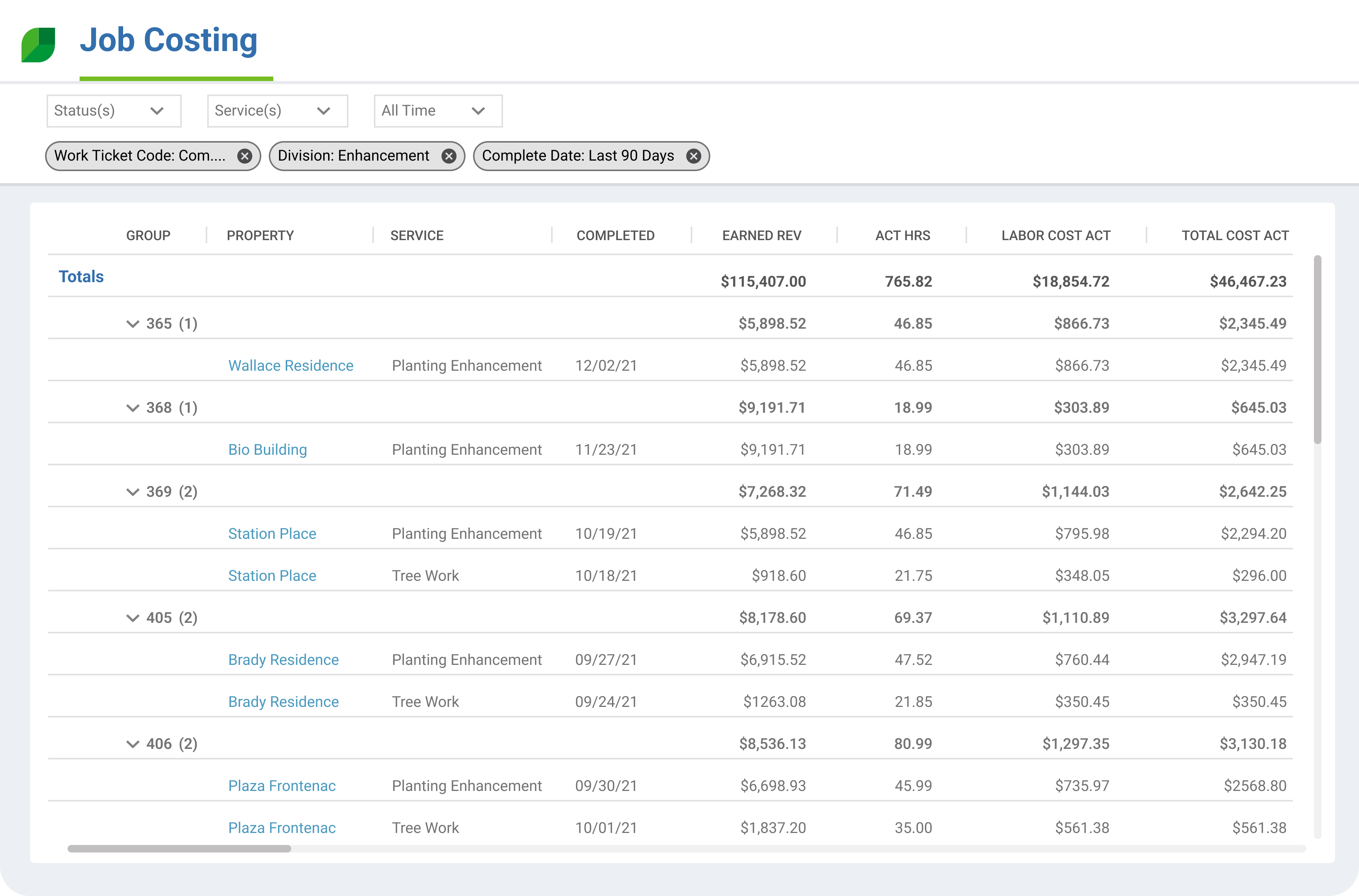
It factors in indirect job costs such as fuel, insurance, administrative fees, and taxes.
This gives you an accurate view of actual costs, helping you calculate labor, materials, and overhead for future projects.
Automated estimating tools: Using insights from the job costing platform and pre-set rates from your existing catalog, Aspire lets you build estimates for clients in just a few steps.
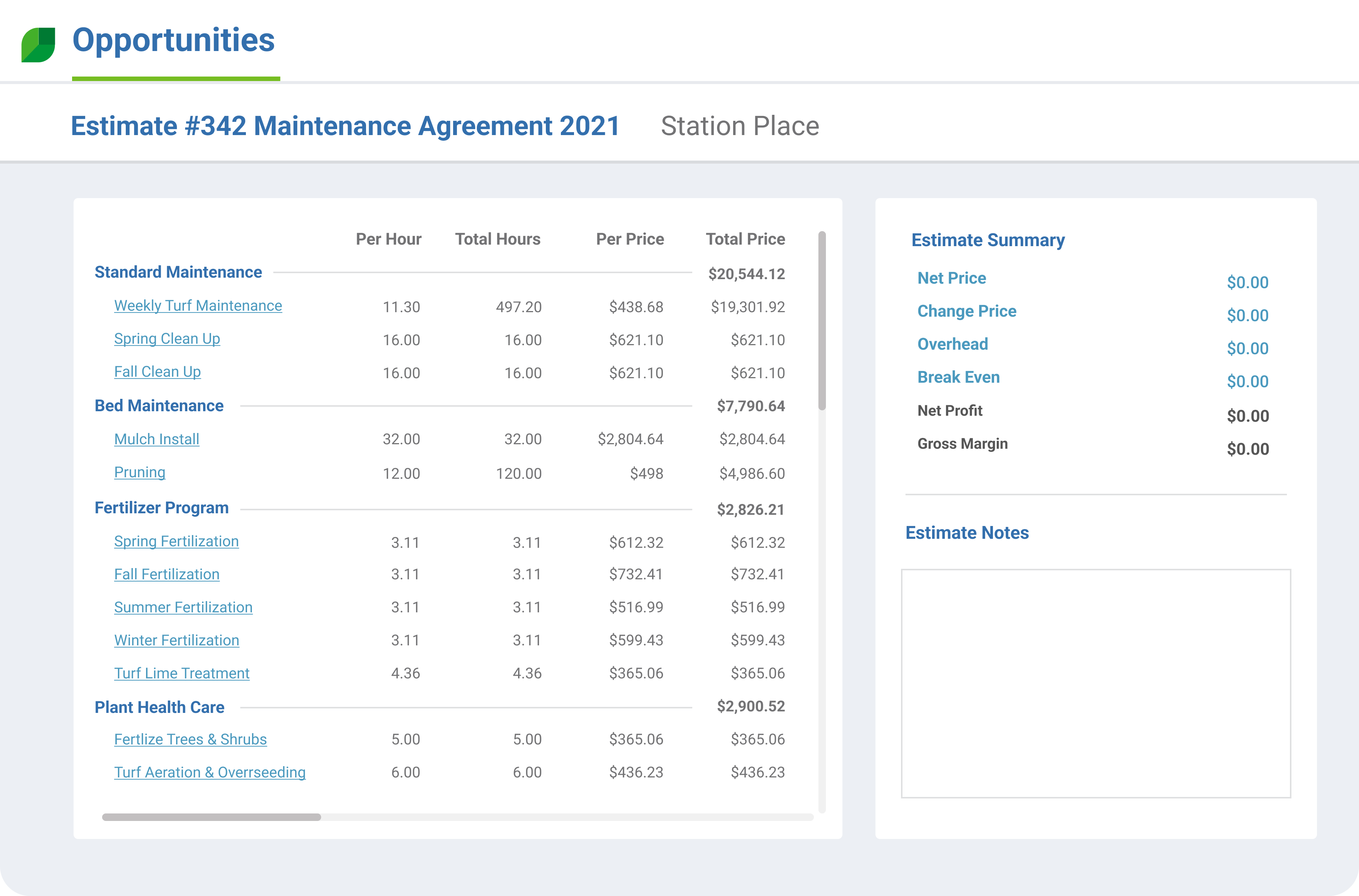
You won’t have to manually calculate overhead or material costs, reducing errors in your quotes and keeping prices consistent.
Detailed reporting: Aspire provides in-depth financial insights by client, crew, and service type, allowing you to compare projected and actual profit margins.
This way, you can refine future markups to achieve the highest profit margins.
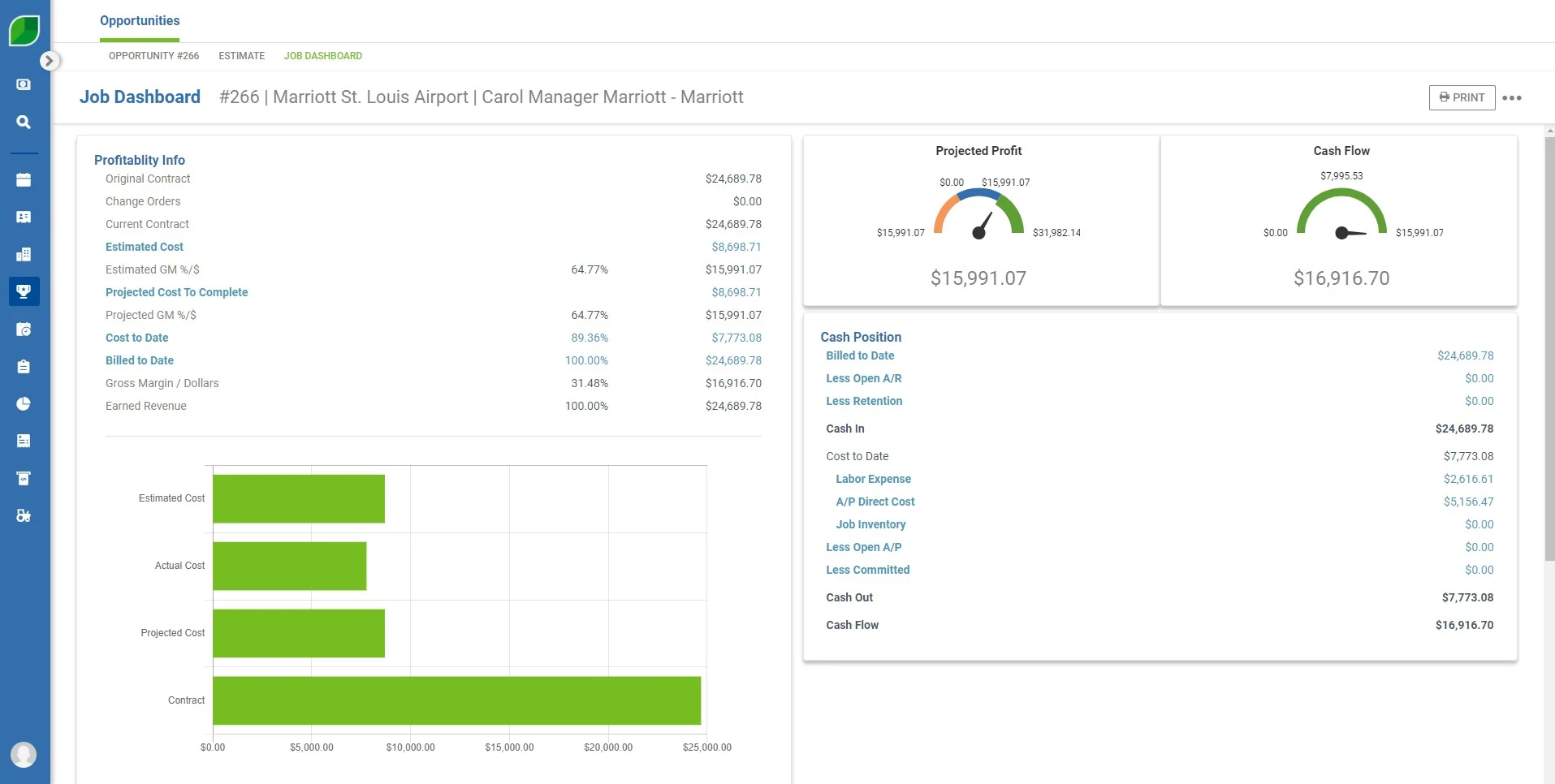
Aspire is also integrated with accounting systems, such as QuickBooks, to ensure accurate and up-to-date cost data. As such, markups can reflect real-time expenses and not outdated numbers.
Want to see these Aspire features in action?
Schedule a free live demo to get a firsthand experience of Aspire.





 866-727-7473
 Schedule Demo
 390 S Woods Mill Rd #300 Chesterfield, MO 63017


