Table of Contents
Table of Contents
- Key factors influencing snow removal pricing
- Residential
- Labor costs
- Equipment costs
- Property size
- Commercial
- Equipment and labor costs
- Overhead costs
- Job size and scope
- Understanding overhead costs in snow removal
- Insurance costs
- Fuel costs
- Employee wages
- Equipment maintenance
- Bills/utilities
- Licensing and permits
- Residential Snow Removal Pricing Models
- Per-visit pricing
- Per-inch pricing
- Hourly pricing
- Seasonal contracts
- Commercial Snow Removal Pricing Models
- Per-hour pricing
- Per-event pricing
- Seasonal contracts
- How Aspire helps snow removal businesses stay profitable
- Frequently asked questions (FAQs)
- What’s the most affordable way to remove snow?
- Are there any eco-friendly snow removal methods?
- How often should snow removal be done during a snowstorm?
- How do weather conditions affect snow removal costs?
You offer snow removal services but have struggled to set profitable pricing. You can’t afford to be uncertain, as this means not getting bids, under- or overpricing your services, and losing clients.
Perhaps you’re just starting your snow-clearing business and want to give your clients fair pricing so they can keep coming back.
Either way, this article will teach you how to price snow-clearing projects using proven strategies.
You will learn about the:
Unique factors that influence snow removal prices
Overhead costs in this business and how to manage them
Different pricing models that help you offer competitive and profitable prices
Key factors influencing snow removal pricing
Snow removal pricing isn't one-size-fits-all, as your costs will vary based on property size and characteristics, service frequency, equipment needs, and local market conditions.
For instance, the cost of an individual snow removal visit for a long-term contract that requires regular visits might be lower than a pay-per-visit model.
Understanding these variables will help you develop accurate quotes that cover your costs while remaining competitive.
Residential
Here are the factors that affect residential snow removal pricing.
Labor costs
Labor is a major factor in pricing snow-clearing residential jobs, as labor rates depend on regional labor markets and the standard of living.
If the average rate, for example, is $22/hr in your city, you either have to pay that rate or more.
Your labor costs also depend on the number of workers, the time required to complete the job, and the overtime needed.
Equipment costs
When pricing, you need to factor in equipment maintenance for wear and tear, replacements, and fuel usage.
Even though residential snow removal often involves small equipment, this, too, can develop faults over time. Budgeting for equipment upkeep ensures you maintain profitability without compromising quality.
Property size
Larger driveways, longer sidewalks, or properties with more obstacles and limited accessibility take more time and fuel to clear.
If there are landscaping features (e.g., flower beds), clearing needs to be done with even more precision and care, which increases service time and costs.
Commercial
Pricing commercial projects differs from residential jobs because they involve larger service areas, heavier equipment, and higher expectations for safety and accessibility.
Here are the different factors that affect commercial pricing.
Equipment and labor costs
Given that you rely on heavy machinery (such as plow trucks, skid steers, and salt spreaders) and work with a larger, skilled crew, your pricing needs to include maintenance costs and expert rates.
If there are snowstorms that require your crew to work extended hours, your labor rates need to reflect that, which in turn affects the project’s cost.
Overhead costs
Expenses such as insurance, fuel, safety training, and other administrative costs are essential for working on high-traffic properties.
You need to include them in operational costs to ensure sustainability throughout the season.
Job size and scope
Commercial projects vary in complexity and scale.
Large properties with huge parking lots, obstacles, or multiple entrances increase the clearing time and resources required. This determines how much you can charge, especially when snowfall exceeds 3 inches.
Whether you’re working on residential or commercial projects, behind-the-scenes costs like insurance and maintenance can erode your profit margins quickly if they’re not properly managed.
That’s why you need to account for overhead costs when pricing jobs. The next section explains these expenses so you can plan for them.
Understanding overhead costs in snow removal
Overhead costs are the ongoing expenses required to keep your snow removal business operational, whether you're actively plowing or not. Think equipment storage, management software subscriptions, internet, fuel, and insurance.
Failing to include these costs in your pricing means you risk undercharging and losing money on every job.
Here are the key overhead expenses you need to factor into your rates.
Insurance costs
You need insurance, such as vehicle policies, general liability, and equipment insurance, to protect your business, crew members, and clients in the event of incidents.
In fact, it’s a requirement for commercial and government jobs.
As such, you need to add its cost to your project’s pricing by distributing it across different contracts.
You can add a small percentage of the total annual premium to each job’s pricing. This way, each contract helps cover your insurance expenses based on the project size, risk level, or clearing frequency.
Fuel costs
Whether you’re working on a residential or commercial project, fuel is needed for your vehicles and powered machinery.
Calculate the cost of fueling your vehicle and equipment for a job, and include it in the service quote.
Keep in mind factors like the site’s distance from your office, the property’s size, and the equipment’s fuel consumption.
Employee wages
Besides your field crew, whose wages are typically classified as labor costs, other employees (such as administrative staff and yourself) constitute a major part of overhead costs.
These workers contribute to overall operations, but aren’t front-facing like the field crew. To factor their wages into your pricing, spread them across all snow removal jobs.
Equipment maintenance
Estimate the annual repair and upkeep costs, such as oil changes, tire changes, part replacement, or blade sharpening, and spread them across all job quotes.
Adjust each quote based on how the equipment will be used on the property. If a snowplower will be used heavily, for example, include an additional maintenance cost in your pricing.
Bills/utilities
Whether you have a physical office or a storage space, you likely need to pay rent, electricity, water, heating, a software subscription, phone services, and the internet.
These expenses should also be included in your pricing by spreading them across all quotes.
Licensing and permits
Some jobs may require a permit for you to execute them, especially commercial and municipal projects. In such cases, factor the cost of getting the license into the project’s quote.
If multiple jobs require permits, distribute the cost across them.
Residential Snow Removal Pricing Models
You can use this formula to guide how you calculate snow removal prices:
(Your hourly rate x Number of hours + Overhead + Materials) x (1 + Profit Margin %)
However, you first need to know the average snow depth in your city after each event, how long it takes you to clear it, and your competitors’ pricing.
This helps set a profitable hourly rate.
You could price snow-clearing services on a per-visit, per-inch, per-hour, or per-season basis.
Here’s a breakdown of each model and how to calculate your prices.
Per-visit pricing
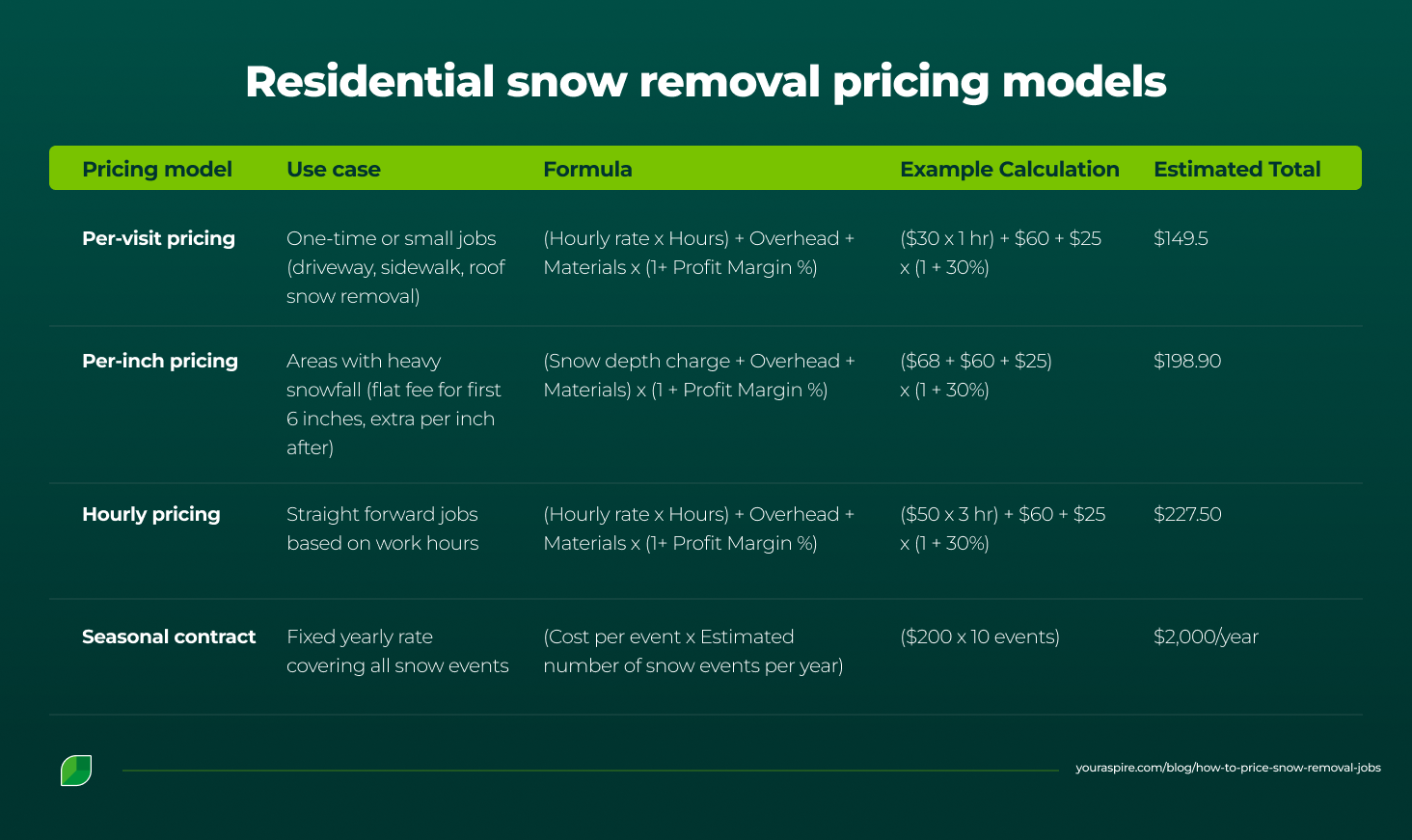
Per-visit pricing means that clients pay a flat fee each time you remove their snow.
Use this model when quoting small or one-time projects, like driveway clearing, sidewalk shoveling, or roof snow removal.
To set profitable prices for this model, you need to know how much other companies in the area are charging.
You also need to account for materials, overhead, the estimated time the job will take, the number of workers, and a base rate to calculate the total job costs.
Here’s what that looks like with an average hourly snow removal rate of $30, $25 material cost, $60 overhead, and 30% profit margin:
(Your hourly rate x Number of hours + Overhead + Materials) x (1 + Profit Margin %)
($30 x 1 hour + $60 + $25) x (1 + 30%) = $149.50
Per-inch pricing
Do you operate in a region with heavy snowfall? Charging per inch might be more profitable for you without undercutting yourself.
You can set a flat fee for the first 6 inches of snow and add a fixed amount for each additional inch if the snow exceeds 6 inches.
According to Lawn Love, many contractors charge between $10 and $25 for the first 6 inches and $4 to $9 for each additional inch.
So, for a 4-inch snowfall, their base rate can be 4 x $10 = $40.
And for an 8-inch snowfall: (6 x $10) + (2 x $4) = $68.
You can use this formula to calculate your total price:
(Snow depth charge + Overhead + Materials) × (1 + Profit Margin %)
Using the same $25 material cost, $60 overhead, and 30% profit margin for an 8-inch snowfall, you’d get: ($68 + $60 + $25) x (1 + 30%)= $198.90
Hourly pricing
This is one of the easiest ways to price snow removal projects. You simply decide on an hourly rate and multiply it by the hours the job will take.
Then, add the material costs, your overhead, and profit margin to the final price.
With a $25 material cost, $60 overhead, 30% profit margin, and $50/hr for a three-hour project, your estimated quote for the job will be:
$50 x 3 hours + $60 + $25 x (1 + 30%) = $227.50
Seasonal contracts
Seasonal pricing means your customers pay a flat fee for the entire year. It’s ideal for areas with high snowfall and homeowners who want consistent service.
Seasonal contracts also mean consistent revenue for your business throughout the winter months.
To ensure you’re profitable with this pricing model, assess your competitors’ pricing in the region and check the average number of snow events per year.
Evaluate what it’d cost to clear snow for one event up to four inches, including overhead, material, and profit margin. Then, multiply it by the number of snow events in the year. This should give you an estimate for profitable seasonal pricing.
So, if there are 40 snow events in a year, and it costs $250 to clear a client’s snow up to four inches, the seasonal charge should be 40 x $250 = $10,000.
This baseline assumes most events are around 4 inches. For variability, you can add a fixed amount for each additional inch when the snow exceeds 4 inches.
Commercial Snow Removal Pricing Models
Unlike residential clients, commercial and government organizations can’t afford per-visit pricing. They typically have larger properties and heavy foot traffic, which means increased slip-and-fall risks.
Commercial clients need regular removal services during winter and pricing models that guarantee prompt service and rapid response time.
Here are the top options contractors use:
Per-hour pricing
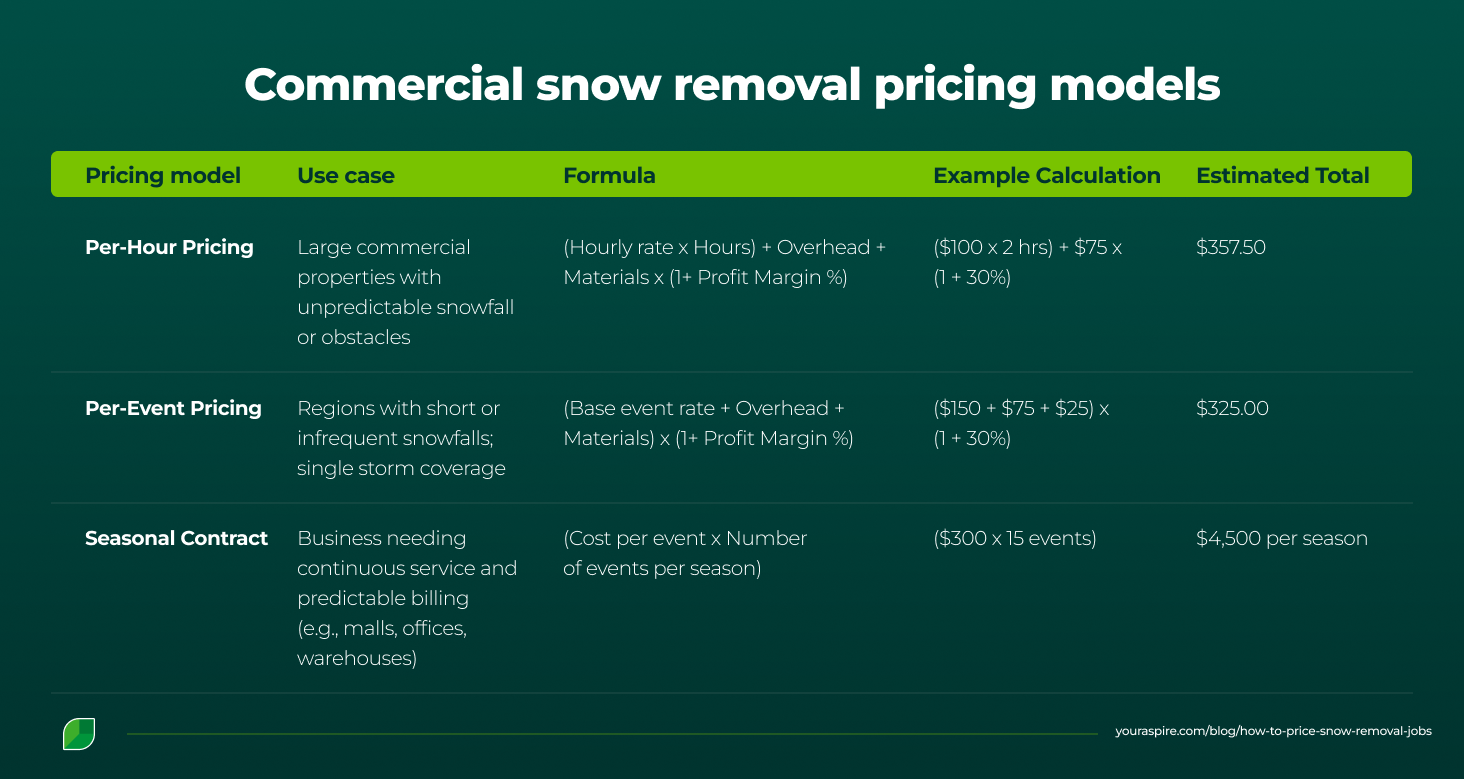
Charging hourly accounts for the time required to clear snow and its depth.
Here’s an example to help you understand better:
According to Homeguide, the commercial hourly rate is $50-$150.
Overhead and material expenses: $75
Time required to plow snow: 2 hours
So, you can charge: ($100 x 2 hours + $75) x (1 + 30%) = $357.50
Per-hour pricing is best used during unpredictable snowfall and when dealing with large commercial properties with obstacles.
Per-event pricing
Use this model to charge clients in regions with light or infrequent snowfalls. You charge a flat rate for each snow event and decide on a trigger depth with the client.
To price this model, first check what your competitors are doing for the same model. For example, Angi reveals that contractors charge between $75 and $200 per event.
Then, add your overhead, material, and margin to be profitable.
Seasonal contracts
Commercial clients such as shopping malls, bank offices, or warehouses that require snow removal throughout the winter season often prefer seasonal contracts.
Clients like this provide your business with predictable income and ensure they have guaranteed service during the season.
To determine a profitable price for seasonal contracts, you need to know your total annual snowfall in inches and the average depth per snow event.
Let’s say you get 45 inches of snowfall a year with an average of 3 inches per fall.
Divide the total snowfall by the average snowfall to get the number of clearing events you’d average for the season.
45 / 3 = 15 snow plowing events per year.
To get the seasonal snowfall pricing, estimate the cost of clearing the property after such an event and multiply it by 15.
If it costs $300, you can charge $300 x 15 = $4,500 for 1-3 inches of snowfall per season.
You can include additional services, such as salting or ice-melt, in the contract to increase your revenue.
How Aspire helps snow removal businesses stay profitable
Pricing snow removal projects requires accounting for labor, equipment, overhead, fuel, and weather variability.
Since your income fluctuates with snowfall frequency, how do you adjust other variables without over- or undercharging clients for your services?
Aspire’s software gives you the tools to stay profitable:
Job costing: This feature allows you to track estimated costs against actual job pricing. Say your initial calculation for a snow removal bid showed $100 is enough to cover materials, and $25 for the vehicle and equipment fuel.
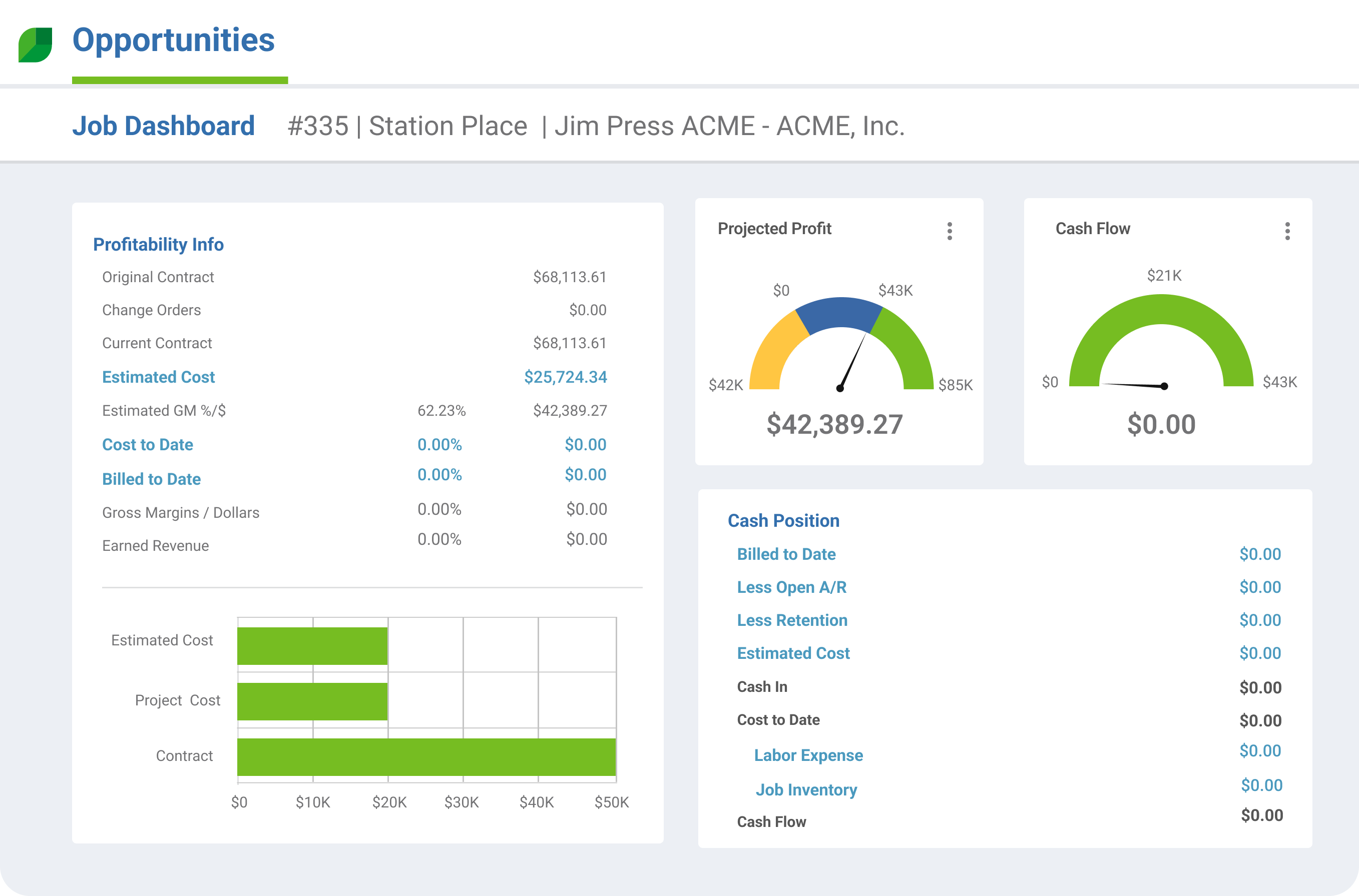
The job costing tool monitors these expenses as your crew logs them into the system, showing whether you're on budget, over budget, or turning a profit.
This helps inform your future pricing, so you can raise your rates or cut costs to stay profitable.
Real-time scheduling: Aspire’s scheduling tool allows you to deploy teams efficiently during storms.

With features like route optimization and job ticket, you can ensure the crew wastes fewer hours navigating and executing the project.
This means lower per-job costs and high revenue potential.
Crew tracking: This field service management tool enables your crew to clock in/out, log hours, and materials used.
It gives you an overview of the crew’s schedule in real time, making it easy to plan routes, take on new jobs, and assign projects.
Reporting and performance insight: With Aspire, you get detailed visibility into each project’s performance. It lets you track labor hours, equipment usage, and costs, including profits and losses.
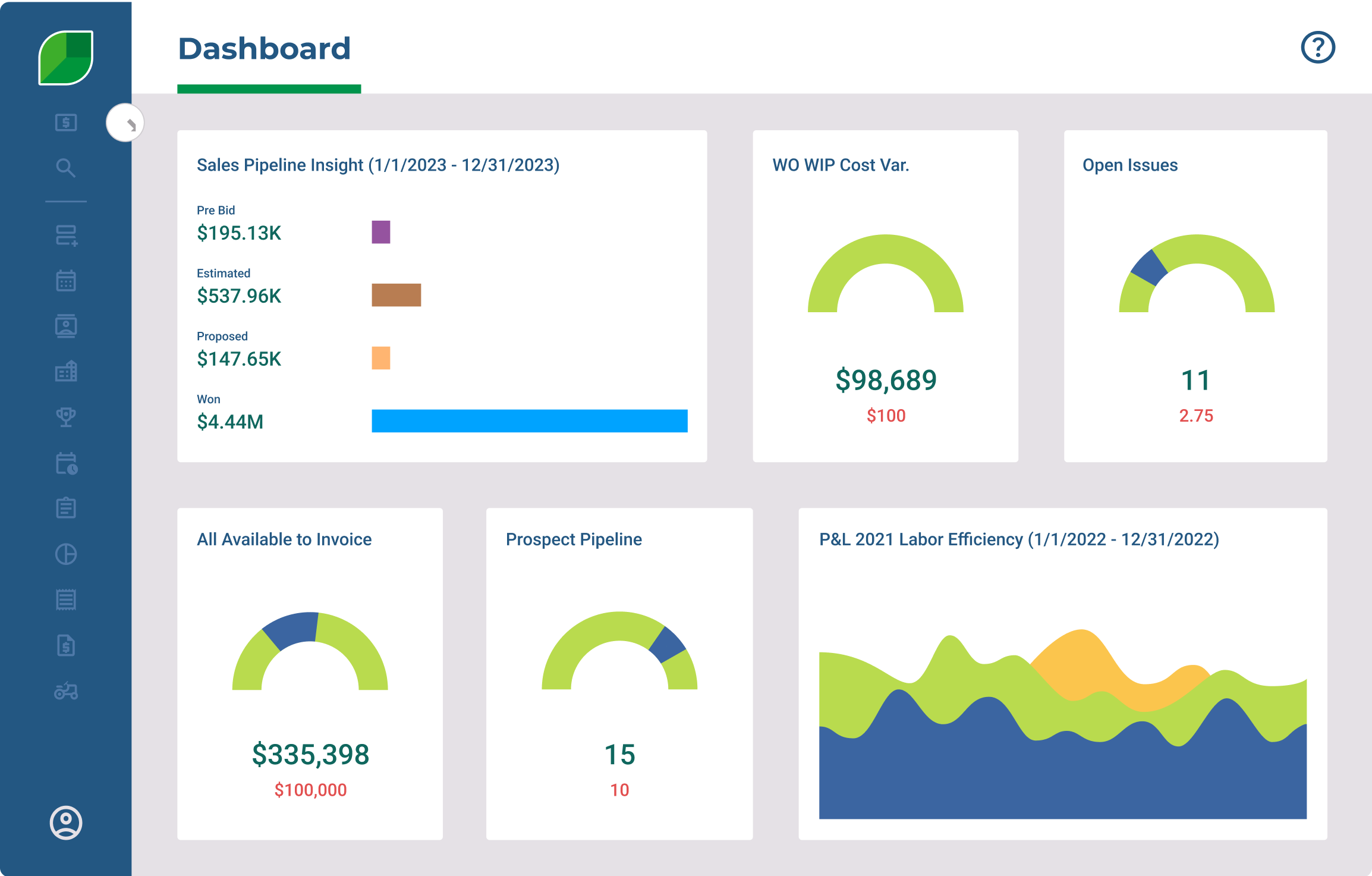
Based on that information, you can decide to adjust pricing, shift a particular crew to closer locations, or retire projects with low profit margins.
Invoicing and payment processing: Generate invoices from your estimates and send them to clients directly in Aspire. You can also receive payments through the platform, ensuring faster cash flow for your business.
Want to see how all these work in real time?
Schedule a free demo with Aspire today!
Frequently asked questions (FAQs)
What’s the most affordable way to remove snow?
The most affordable way to remove snow is to do it yourself using manual tools like shovels or pushers, especially in small areas.
But for larger areas, using a snow blower you own should be cost-effective. Some other options to consider include:
Hiring contractors on a per-visit or event basis.
Applying brine solutions to prevent ice bonding before snow falls.
Are there any eco-friendly snow removal methods?
Yes, here are some methods to try:
Use electric snow blowers for clearing projects.
Apply biodegradable de-icers or sand instead of salt.
Install heated driveways to melt the ice and reduce chemical use.
Use brine solutions before snowstorms.
How often should snow removal be done during a snowstorm?
During a snowstorm, plan to remove snow every 3 inches to prevent buildup. Doing this periodically prevents compaction, reduces physical strain, and helps maintain a safe surface throughout the storm.
How do weather conditions affect snow removal costs?
Extreme weather conditions, such as heavy or wet snowfall, require more time, labor, and fuel to clear the snow, increasing overall expenses.
In icy conditions, you may even need additional materials such as salt, brine, or de-icing chemicals.







 866-727-7473
 Schedule Demo
 390 S Woods Mill Rd #300 Chesterfield, MO 63017


