![Business License for Snow Removal: Complete Guide [2026]](/_next/image?url=https%3A%2F%2Fimages.ctfassets.net%2F3cnw7q4l5405%2F54vTHqiZECCBsUE6QSgrDV%2F3102ace7fa87221aed84ecc035608461%2FBusiness_license_for_snow_removal.png&w=3840&q=75)
Table of Contents
Table of Contents
- What is a snow removal business license?
- Do I need a license for snow removal?
- How do I get a snow removal license?
- What common business licenses and permits are required for snow removal?
- Where do I apply for a snow removal license?
- How much does a snow removal license cost?
- What insurance is needed for snow removal work?
- What happens if I work without a license?
- Can seasonal workers operate under my license?
- Set up your business for success
Snow removal is a highly profitable industry, expected to be worth around $124.7 billion by 2034.
However, despite the great potential, starting a snow removal business requires more than just buying the right equipment and being determined to succeed.
You’ll first need the proper business license to operate legally.
But how do you obtain one?
In this guide, you’ll discover:
Why you need a snow removal license
Key steps to obtain it
What the common business licenses are
Where to apply for one
How much a license costs
What happens if you work without a license
Let’s dive right in.
What is a snow removal business license?
A snow removal business license is an official permit that allows someone to legally operate a snow removal business within a city, county, or state.
While you can work without one, a license ensures that businesses meet local and state regulations, shields them from liabilities inherent in snow removal, and builds trust with clients.
Be careful, though, as requirements vary by jurisdiction. For example, some states tie snow removal licenses to general contractor rules or environmental regulations.
More info on this in the next section.
Do I need a license for snow removal?
The short answer: it depends on your location.
The long answer: whether you need a license to operate a snow removal business varies by local municipality or county. Generally, you need a general business license, liability insurance, workers’ compensation coverage, and a commercial driver’s license to operate snow plows.
For instance, New York requires a business license and liability insurance, whereas states such as Pennsylvania require no special permits beyond a business license.
Other counties might not have stringent rules, especially for small-scale jobs. Some might require you to hold a contractor’s license, while others impose additional obligations such as local permits or environmental regulations.
Be sure to check with local authorities to determine what you need to obtain a license.
Let’s see what steps you need to take to get your snow removal business permit.
How do I get a snow removal license?
Getting a snow removal license varies by state, but the process typically includes registering your business, gathering the required documents, and submitting your application.
Before beginning your licensing journey, research your local requirements to follow the proper steps, as some jurisdictions may require equipment inspections, background checks, or a commercial driver’s license (e.g., to operate heavy plow trucks).
Register your business
First, choose a business structure that fits your needs, such as a sole proprietorship, limited liability company (LLC), or corporation. Each comes with its own benefits and disadvantages, as well as different rules and liability protections.
In general, LLCs are the most popular choice for snow removal businesses because they separate personal and business assets.
Once you’ve decided, register your business with the state to ensure it is legally recognized. If you plan on hiring a crew or opening a business bank account, you’ll also need an employer identification number (EIN) from the IRS.
Gather required documents
After registering your business, it’s time to collect the paperwork most licensing offices require.
Common documents include proof of insurance, such as commercial auto coverage, a valid identification or formation documents, and a copy of your business registration. In some areas, you will need to provide details about the equipment you use.
Be prepared for additional checks, such as a tax identification number or a signed compliance form confirming that you follow local regulations.
To speed up the license application process, have these documents ready in advance; it’ll make things easier and smoother.
Submit your application
The last step is submitting your snow removal license application. Depending on the jurisdiction, you apply online, by mail, or in person at the office.
A word of advice: double-check all required fields, pay all your fees, and attach any supporting documents. A single missing insurance certificate or an incorrect business name unnecessarily delays the process, so make sure everything is in order.
Usually, you’ll receive a confirmation number or an email to track your application status online. If processing takes longer than expected, you can follow up with the licensing office.
Moving forward, let’s see what type of licenses a snow removal business could require.
What common business licenses and permits are required for snow removal?
Naturally, you need a general business license. But operating a snow removal business requires more than that.
Depending on the services you offer and where you’re operating, you need the following:
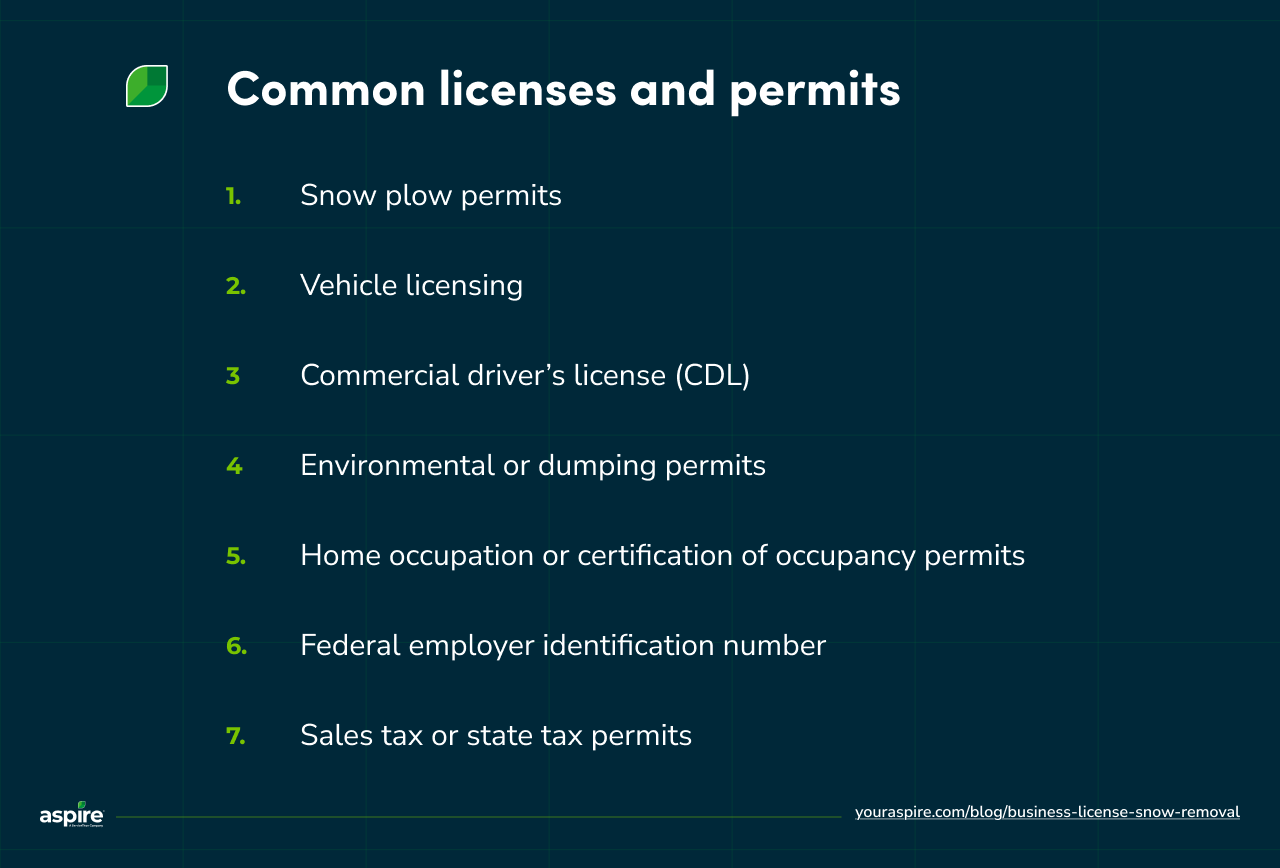
1. Snow plow permits
Some communities require special permits to operate a snowplow on public roads and to clear parking lots or commercial properties. Show proof of liability insurance and current vehicle registration and, in some cases, allow inspection of your plow equipment to ensure it meets safety standards.
Without proper authorization, you risk facing fines or restrictions where you can legally plow, so make sure to check in with authorities before winter begins.
2. Vehicle licensing
Typical snow removal jobs require the use of a truck. You must register it with the Department of Motor Vehicles and obtain a commercial license to operate it on public roads.
Proper vehicle registration allows you to avoid fines and protects your business in case of accidents or liability claims.
3. Commercial Driver’s License (CDL)
If you operate heavy-duty trucks, you also require a commercial driver’s license (CDL), which allows you to operate large or specialized vehicles.
The requirements vary by state, but the driver usually has to pass a written knowledge test and a practical driving exam. If you want to carry hazardous materials, like salt or chemical de-icers, you also need endorsements.
Having a valid CDL protects your business and employees from liability issues and ensures compliance with federal regulations.
4. Environmental or dumping permits
If you plan to dump the snow somewhere, you need a special permit to dispose of the collected snow, which is often mixed with salt, sand, or debris. Some municipalities prohibit dumping on public streets, waterways, or private properties without permission.
Obtaining a permit involves applying through local environmental departments and demonstrating how you will safely dump the snow.
Failing to get this permit results in fines, cleanup costs, and even legal action. Understanding local environmental rules ensures your snow removal business operates responsibly.
5. Home occupation or certification of occupancy permits
Is your business operating from home? You will need a special license to comply with local zoning laws.
A home occupation permit allows you to legally operate a snow removal business from a residential property without violating zoning regulations (e.g., noise, vehicle storage). In some states, for example, you need to confirm your home is suitable for business operations and meets safety codes.
Having this permit ensures your office does not negatively impact the community or the neighbors, even if your operations are primarily off-site, and helps you avoid fines.
6. Federal employer identification number
A federal employer identification number (EIN) is a unique ID assigned by the IRS to your business for tax purposes.
Even if you don’t plan on hiring employees, an EIN is required for opening business bank accounts and filing federal taxes. The best part is that obtaining this code is free and can be done entirely online through the IRS website.
For businesses structured as partnerships, LLCs, or corporations, the EIN is mandatory.
Using an EIN instead of your personal Social Security number also separates personal and business finances, which is vital for liability purposes.
7. Sales tax or state tax permits
Finally, the sales or state tax permit allows your business to legally charge sales or state taxes on products and services.
Some states exempt snow removal services from sales tax, but some jurisdictions require permits if you sell products like ice melt or equipment.
To avoid penalties, ensure proper tax reporting, and that you can legally operate your business within the state.
With this out of the way, let’s see where to apply for a snow removal license.
Where do I apply for a snow removal license?
Don’t know where to apply for a snow removal license? Depending on your location, here are some options:
Local city hall: Many municipalities issue snow removal permits and business licenses directly, so city hall is the best place to look.
County clerk’s office: Some counties manage licensing for businesses that operate across multiple areas.
State licensing boards: Some states centralize contractor or commercial vehicle licensing at the state level.
Online portals: Many areas now offer electronic applications for faster processing and payment.
Seasonal in-person events: Attend annual registration events before winter arrives—they help contractors get licensed and insured quickly.
Be sure to check your specific jurisdiction’s website to ensure you follow the correct process and meet all deadlines.
Now, let’s see what a license costs.
How much does a snow removal license cost?
A snow removal license typically costs between $50 and $500, depending on location. For accurate pricing, check with your local government and licensing board.
Costs vary depending on business size, the jurisdiction’s licensing rules, and the type of equipment used. Larger businesses or those operating multiple trucks face higher fees, while residential-only operations pay less.
Some areas charge a one-time fee, while others require annual renewals. Be sure to take into account any special permits (as listed above), commercial vehicle registration, or environmental compliance certifications.
Next up, let’s talk about insurance.
What insurance is needed for snow removal work?
Operating a snow removal business without insurance is a huge red flag. Obtaining the necessary insurance protects your business and workers from potential risks, ensuring continuity and financial stability.
These are the most common insurance policies for a snow removal business:
General liability insurance: Covers third-party bodily injury or property damage claims.
Commercial auto insurance: Protects your vehicles against accidents, theft, or damage. It’s highly recommended for plow trucks operating in hazardous winter conditions.
Workers’ compensation insurance: Provides coverage for medical expenses and lost wages if your employees get injured on the job.
Tool and equipment insurance: Protects your snow removal tools and equipment against loss or damage. This ensures unexpected repairs or replacements do not financially burden you.
What happens if I work without a license?
Operating a snow removal business without a proper license can lead to severe financial and legal consequences.
Penalties often include fines, stop-work orders, legal action by municipal authorities, and even the barring of your business from bidding on commercial contracts. But the most considerable risk is that it undermines your credibility with clients, leading to decreased revenue.
Besides, any property damage, injury, or accidents that occur would make you personally responsible and even result in your insurance being voided.
Can seasonal workers operate under my license?
Yes, seasonal employees are typically covered if they are official employees. However, subcontractors need their own licenses to work legally under your business.
Official employees hired and paid by your company are generally covered under your license and insurance policies. Independent contractors, on the other hand, need their own licenses and insurance, depending on local regulations.
To avoid confusion, have clear written agreements outlining each employee’s scope of work, responsibilities, and insurance coverage. Proper documentation ensures your business remains compliant with the law while protecting your employees.
Set up your business for success
Obtaining the proper snow removal business license requires careful planning to ensure your business gets up and running as quickly as possible.
But what happens once your business is secure?
You start optimizing your operations using Aspire, a field service management platform that transforms any licensed operation into an efficient, profitable business.
Here’s what Aspire does for you:
Streamlines end-to-end workflows, from route planning and scheduling to time tracking and invoicing.
Empowers field workers through a mobile app, providing your crew with real-time updates, GPS tracking, and SMS reminders.
Integrates with tools like PropertyIntel for precise estimating and faster, more accurate bidding.
All these features (and more) are yours if you just book a demo with Aspire. Sign up today.





 866-727-7473
 Schedule Demo
 390 S Woods Mill Rd #300 Chesterfield, MO 63017


